








Description
A Clear Guide to Understanding Data in a World of Numbers
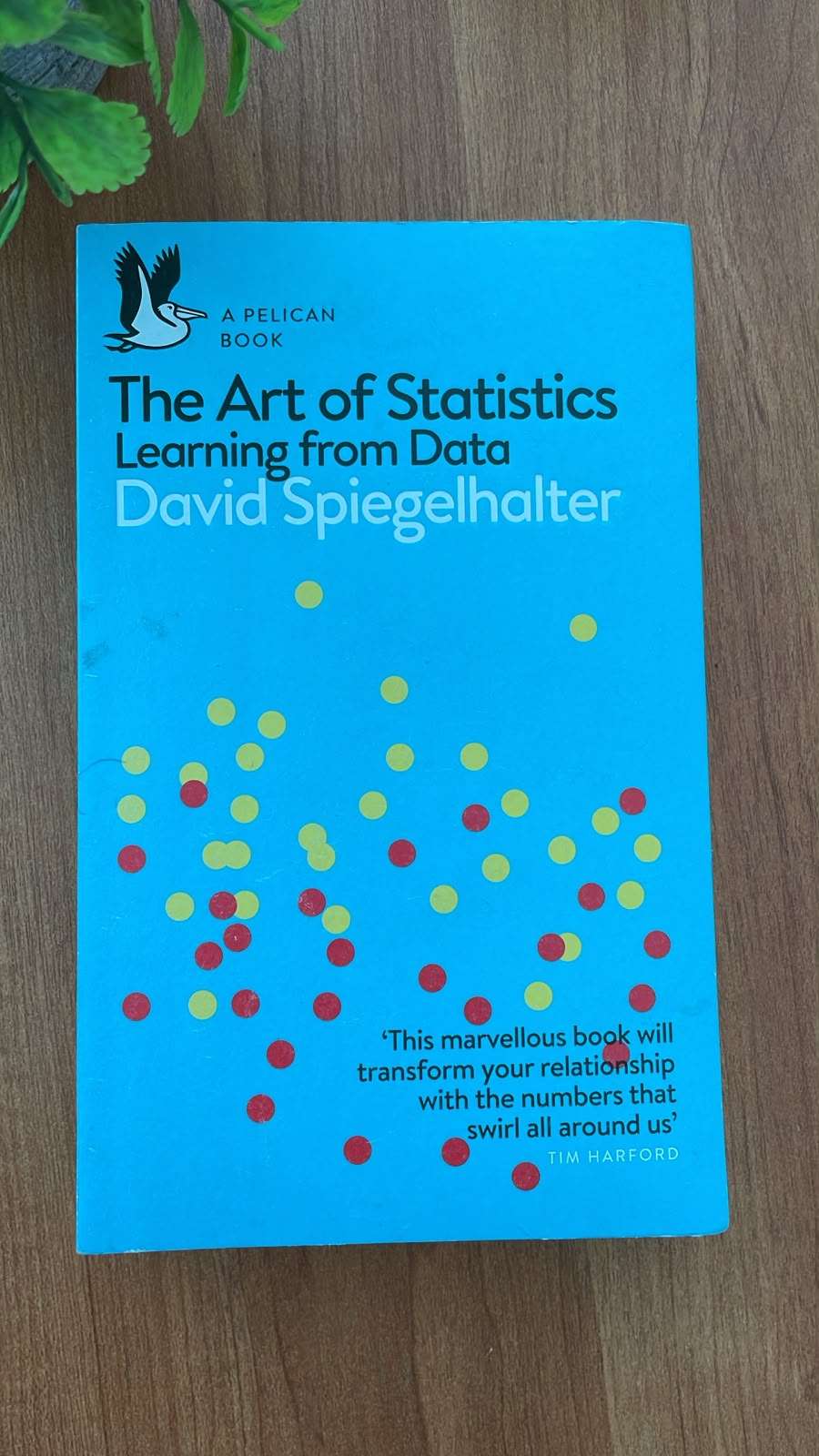
The Art of Statistics by David Spiegelhalter is an accessible yet rigorous introduction to statistical thinking. Rather than focusing heavily on formulas, the book emphasizes how to interpret data critically and make informed decisions in an age dominated by information, risk assessments, and predictive models.
Spiegelhalter’s central message is that statistics is not about complex mathematics alone — it is about asking the right questions, understanding uncertainty, and communicating evidence responsibly.
Core Objective
The book teaches readers how to:
Understand where data comes from
Interpret risk and probability correctly
Identify bias and misleading claims
Communicate uncertainty clearly
Make decisions using evidence rather than intuition
It bridges the gap between technical statistical theory and everyday real-world application.
Key Concepts Explained
1. The Importance of Data Quality
Not all data is reliable. Spiegelhalter stresses examining how data was collected, sample size, measurement error, and potential bias before drawing conclusions.
2. Understanding Uncertainty
A major theme is that uncertainty is unavoidable — and that acknowledging it strengthens credibility. Confidence intervals, margins of error, and probability ranges are explained in practical, intuitive ways.
3. Correlation vs. Causation
The book carefully distinguishes between relationships and true cause-and-effect, highlighting how misinterpretation can lead to flawed conclusions.
4. Risk and Probability
Spiegelhalter clarifies how risk is communicated in media and policy, including:
Relative vs. absolute risk
Expected outcomes
Misleading statistical framing
5. Communicating Numbers Clearly
Statistics is not only about analysis but about presentation. The book emphasizes transparency, clarity, and ethical communication of data.
Real-World Applications
The Art of Statistics applies statistical thinking to:
Medicine and public health
Government policy
Journalism and media reporting
Business forecasting
Everyday personal decision-making
The practical examples make the subject relevant to non-specialists while remaining intellectually robust.
Writing Style and Accessibility
Spiegelhalter writes in a conversational yet authoritative tone. Technical concepts are explained through relatable examples rather than dense equations, making the book suitable for readers without a mathematical background.
Who Should Read This Book
The Art of Statistics is ideal for:
Students studying data, research, or social sciences
Professionals working with reports or analytics
Journalists and policymakers
Anyone seeking to think more critically about numbers in daily life
Lasting Impact
After reading The Art of Statistics, readers typically become more skeptical and analytical consumers of information. The book strengthens quantitative literacy and encourages responsible interpretation of data in a world where statistics influence nearly every major decision.
Explore more mystery and thriller novels:
https://booklounge.lk/product-category/Non-Fiction/
Official academic and professional page:
www




Reviews
There are no reviews yet.