


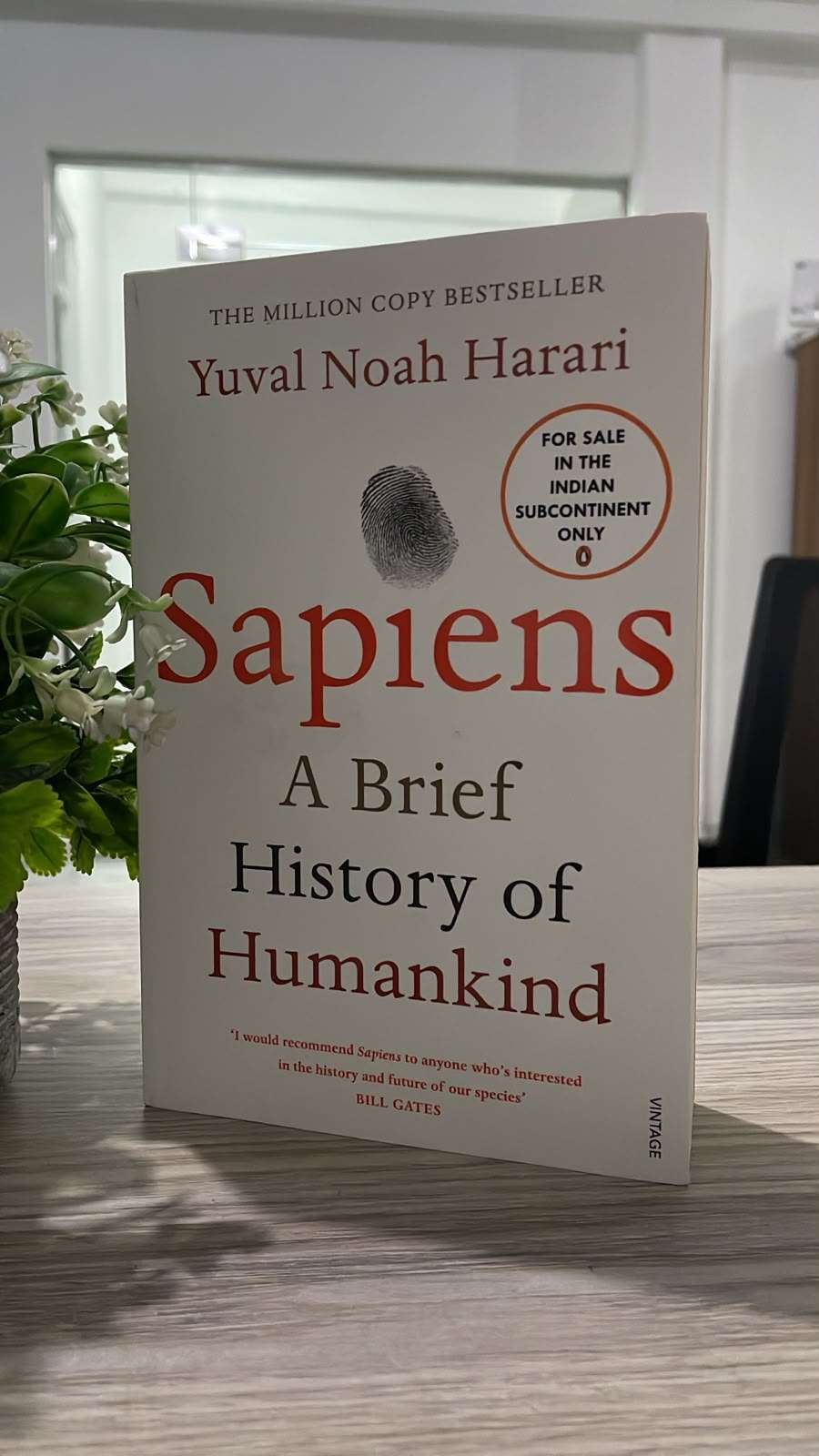






Description
Sapiens by Yuval Noah Harari, published under the complete title Sapiens: A Brief History of Humankind, is an ambitious exploration of how one human species developed the ability to dominate the planet, build complex societies and transform the natural world.
Yuval Noah Harari takes readers across tens of thousands of years of human development, beginning with the emergence of Homo sapiens and continuing through agriculture, cities, empires, religions, capitalism, industrialisation and modern science.
Rather than presenting history only as a sequence of rulers, wars and dates, the book examines the ideas, institutions and shared beliefs that enabled large numbers of strangers to cooperate.
Harari combines history with biology, anthropology, economics and philosophy. His arguments are written for general readers, making large and complicated questions accessible without requiring specialist academic knowledge.
Why Read Sapiens by Yuval Noah Harari?
Sapiens by Yuval Noah Harari encourages readers to reconsider assumptions about civilisation, progress, wealth, religion, politics and human happiness.
Why did Homo sapiens survive while other human species disappeared? How did small groups of hunter-gatherers become nations containing millions of people? Why do strangers trust the same currency, laws, companies and political institutions?
The book argues that human success depends not only on intelligence or physical strength but also on the ability to create and believe in shared stories.
These stories may concern gods, nations, legal systems, corporations, money or human rights. Although they are not physical objects like mountains or rivers, shared belief gives them enormous power within human societies.
A History of the Human Species
The book begins when Homo sapiens was only one of several human species.
Other members of the human family included Neanderthals and additional groups adapted to different environments. Harari examines possible explanations for why Homo sapiens eventually became the only surviving human species.
He also considers the ecological impact of human migration. As humans entered new environments, many large animal species disappeared.
The book therefore challenges the idea that environmental destruction began only with modern factories. Human beings influenced ecosystems long before industrial civilisation.
The Cognitive Revolution
The first major transformation explored in the book is the Cognitive Revolution.
Harari associates this period with major changes in communication, imagination and social organisation. Humans became capable of discussing not only visible objects and immediate dangers but also things that existed mainly through collective belief.
This ability made it possible to organise larger groups. Most animals cooperate only within limited social networks, but humans can work with strangers when everyone accepts the same rules, symbols or stories.
A modern business, country or currency can function because millions of people who have never met one another recognise its authority or value.
The Power of Shared Stories
One of the book’s central arguments is that imagined realities are essential to civilisation.
This does not mean that laws, nations or money are meaningless. It means that their power depends on collective acceptance.
A banknote has limited physical usefulness, but it becomes valuable when buyers, sellers, governments and financial institutions agree to trust it.
A company can own property, employ workers and enter contracts even though the company itself is not a biological person. Its existence depends on legal and social agreement.
Shared stories allow humans to cooperate flexibly on a scale that would otherwise be impossible.
The Agricultural Revolution
The Agricultural Revolution transformed many human communities from mobile groups of foragers into settled populations dependent on cultivated crops and domesticated animals.
Agriculture supported larger populations, permanent settlements and increasingly complex political structures.
However, Harari challenges the simple belief that agriculture automatically improved life for every individual. Early farmers could face repetitive labour, limited diets, disease and dependence on a small number of crops.
The population may have increased even when individual wellbeing did not improve equally.
This distinction between the success of a species and the happiness of individual members appears throughout the book.
From Villages to Cities and Kingdoms
Permanent settlements created new administrative problems. Larger communities needed methods for recording property, trade, taxes, labour and obligations.
Writing, bureaucracy and specialised government developed partly because human memory alone could not manage increasingly complex societies.
These systems made large kingdoms and economies possible, but they also created hierarchies and placed people into social categories.
Harari asks readers to consider how apparently natural social arrangements may have been created historically and then maintained through institutions and belief.
Money as a System of Trust
Money is presented as one of humanity’s most successful systems of cooperation.
People with different languages, religions and political beliefs may still accept the same currency.
Money allows value to be exchanged between strangers and across long distances. It reduces the difficulty of direct barter because a farmer does not need to find someone who wants grain and can provide exactly the desired product in return.
The system works because participants trust that other people will also accept the money later.
Harari therefore treats money not merely as metal, paper or digital records but as a shared system of confidence.
Empires and the Unification of Humankind
The book examines empires as major forces in cultural and political history.
Empires often expanded through violence, conquest and exploitation. At the same time, they connected distant regions, languages, technologies and systems of administration.
Harari avoids presenting history as a simple struggle between completely separate and unchanging cultures. Conquest, migration and trade repeatedly caused cultures to influence one another.
Many modern languages, borders, laws and customs developed through these complicated historical encounters.
Religion and Universal Orders
Religion is another important source of large-scale human cooperation.
Religious traditions can provide moral rules, shared rituals and explanations of existence that unite people beyond family or local communities.
The book considers both monotheistic and polytheistic traditions as well as systems such as Buddhism, liberalism and humanism.
Harari uses a broad definition of religion and ideology, which makes this one of the book’s more provocative sections.
Readers may agree or disagree with his classifications, but they encourage examination of how beliefs create social order and legitimacy.
The Scientific Revolution
The Scientific Revolution begins, in Harari’s account, with a willingness to admit ignorance.
Earlier societies possessed knowledge and curiosity, but modern science developed systematic methods for recognising what remained unknown and seeking evidence through observation, mathematics and experimentation.
This approach gradually produced major advances in medicine, navigation, engineering, astronomy and technology.
Scientific research also became connected to governments, military power, commercial interests and imperial expansion.
The book therefore presents science not as an isolated activity but as part of a wider relationship between knowledge, money and political ambition.
Capitalism, Credit and Economic Growth
Modern economies depend heavily on confidence in future growth.
Credit allows governments, companies and individuals to use expected future income in order to invest in present opportunities.
A business may borrow money to build a factory because both the owner and lender believe the factory will generate future revenue.
Harari connects this confidence in growth with capitalism, scientific research and overseas expansion.
He also examines the moral and social consequences of a system that continually seeks greater production and consumption.
Industry and the Use of Animals
The Industrial Revolution increased human power and productivity, but the book asks readers to examine its effect on other animals.
Modern farming can treat animals primarily as units of production, even though those animals possess biological and behavioural needs.
Harari argues that the success of domesticated species cannot be measured only by population numbers. A species may become numerous while individual animals experience restricted and difficult lives.
This section connects economic history with questions of ethics and animal welfare.
Did Progress Make Humans Happier?
Greater wealth, medicine and technology have improved many aspects of life, but Harari asks whether modern humans are necessarily happier than earlier people.
Happiness may depend on expectations, relationships, physical conditions, meaning and individual psychology rather than material power alone.
A society can produce more goods while also creating stress, isolation or dissatisfaction.
The book does not provide one simple measurement of happiness. Instead, it argues that historians should examine human experience as well as political and economic achievements.
Consumerism and Modern Identity
Modern societies often encourage people to express identity through products, experiences and lifestyle choices.
Consumer culture teaches that purchasing something new may create happiness, status or personal fulfilment.
At the same time, modern individualism encourages people to see themselves as independent decision-makers.
Harari examines how markets and states may support this individual freedom while weakening some older family and community structures.
The Future of Homo Sapiens
The final sections look beyond recorded history towards biotechnology, artificial intelligence and genetic engineering.
Humans are gaining the ability to change bodies, minds and biological processes rather than depending only on natural evolution.
This creates extraordinary opportunities but also serious ethical questions.
Who will control these technologies? Who will be able to afford them? Could biological enhancement create new forms of inequality? What should humanity choose to become?
The book ends by suggesting that increased power does not automatically produce wisdom. The ability to transform life makes responsible decision-making increasingly important.
A Multidisciplinary Work
Sapiens moves between history, anthropology, biology, economics, religion and philosophy.
This broad approach makes the book stimulating and accessible, but it also means that many complicated subjects are summarised within limited space.
Readers should view the book as a large interpretive synthesis rather than the final authority on every subject it discusses.
Some arguments are deliberately provocative and have generated debate among historians, anthropologists, philosophers and scientists.
The strongest reading approach is to engage with the questions, compare Harari’s claims with additional sources and distinguish established evidence from broad interpretation.
Major Themes in Sapiens
The book explores subjects including:
- Human evolution and the disappearance of other human species
- The Cognitive Revolution and the development of complex language
- Shared myths and large-scale cooperation
- The Agricultural Revolution and settled societies
- The growth of cities, kingdoms and empires
- Money as a shared system of trust
- Religion, ideology and social order
- Capitalism, credit and economic growth
- Science, imperialism and technology
- Animal welfare and environmental destruction
- The relationship between progress and happiness
- Biotechnology and the possible future of humanity
Who Should Read This Book?
This book is recommended for:
- Readers interested in world history
- Students of anthropology and sociology
- Readers interested in human evolution
- Fans of popular science and big-history books
- Readers exploring politics, economics and religion
- Teachers and university students
- Book clubs seeking thought-provoking non-fiction
- Readers interested in the future of humanity
The writing is accessible to general readers, although its broad arguments encourage careful and critical reading.
About Yuval Noah Harari
Yuval Noah Harari is a historian, philosopher and bestselling author known for examining the large forces shaping human history and the future.
His other books include Homo Deus: A Brief History of Tomorrow, 21 Lessons for the 21st Century, Nexus, the Sapiens: A Graphic History series and the children’s series Unstoppable Us.
Harari studied at the University of Oxford and has taught history at the Hebrew University of Jerusalem.
In Sapiens by Yuval Noah Harari, he combines historical narrative with questions about biology, imagination, cooperation, power and technological change.
Official information about the book is available from the
Yuval Noah Harari Sapiens page.
Information about the matching Vintage paperback is available from the
official Penguin Sapiens page.
Why Buy from Book Lounge Sri Lanka?
Book Lounge is an online bookstore offering fiction, non-fiction, biographies, children’s books and educational titles to readers throughout Sri Lanka.
Explore similar history, science and educational books through the
Book Lounge Non-Fiction collection.
Browse all currently available titles through the
Book Lounge online store.
For assistance with availability, payments, delivery or an existing order, visit the
Book Lounge contact page.
Buy Sapiens Online in Sri Lanka
Buy Sapiens by Yuval Noah Harari online in Sri Lanka from Book Lounge and explore how biology, imagination, agriculture, money, religion, empires and science shaped human civilisation.
Order Sapiens by Yuval Noah Harari from Book Lounge today and discover a bold, accessible and thought-provoking history of who we are, how we reached the modern world and where humanity may be heading.





Reviews
There are no reviews yet.