






Description
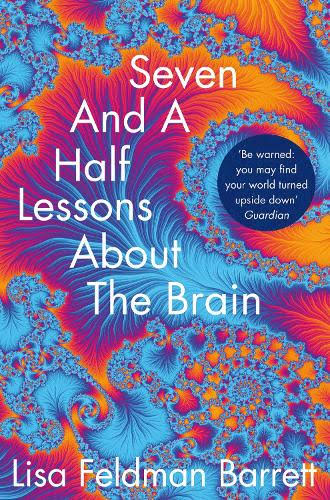
Seven and a Half Lessons About the Brain by Lisa Feldman Barrett
Seven and a Half Lessons About the Brain by Lisa Feldman Barrett
Seven and a Half Lessons About the Brain by Lisa Feldman Barrett is a short, engaging introduction to neuroscience that challenges several popular assumptions about how the human brain works.
Rather than presenting neuroscience through dense technical language, Barrett uses seven short lessons plus a brief evolutionary history of the brain to explain complex ideas in an approachable way. Pan Macmillan describes the book as an accessible collection exploring where brains came from, how they are structured, and how our brains work together with other brains to construct the experiences that make up everyday life.
The result is an ideal book for readers who are curious about psychology, neuroscience, behaviour and human nature but do not necessarily have a scientific background.
Why Do We Have a Brain?
One of the first questions Barrett asks is surprisingly basic:
Why did brains evolve in the first place?
A common assumption is that the brain’s primary purpose is to think.
Barrett challenges that idea.
From an evolutionary perspective, brains developed to help organisms manage the demands of increasingly complex bodies and environments.
Thinking, planning, remembering and feeling are extraordinary abilities, but they exist within a system whose deeper biological task is to keep the body functioning effectively.
This different perspective immediately changes how readers may think about intelligence and consciousness.
Your Brain Is a Network
Another important idea in Seven and a Half Lessons About the Brain is that the brain is not simply a collection of completely independent sections, each responsible for one isolated task.
Popular explanations often describe a “logic area,” an “emotion area” or an ancient “reptilian brain.”
Barrett explains why these simplified models can be misleading.
Modern neuroscience increasingly understands the brain as a highly interconnected network whose systems work together in flexible ways.
Pan Macmillan specifically notes that the book challenges the popular myth of a “lizard brain” and the idea that rational thought and emotion exist in a simple battle for control.
The Myth of the Lizard Brain
You may have heard the claim that humans possess three evolutionary layers:
a primitive reptilian brain,
an emotional mammalian brain,
and a rational human brain.
This idea has become extremely popular in self-help books, business presentations and everyday explanations of behaviour.
Barrett argues that this model does not accurately reflect how vertebrate brains evolved.
Human brains did not simply stack a rational section on top of an animal brain.
Instead, brain evolution involved modifications of shared biological systems over vast periods of time.
Understanding this matters because outdated models can shape the way people interpret emotion, self-control and decision-making.
Thinking Versus Feeling?
Another myth Barrett challenges is that emotion and rationality are completely separate processes.
People often talk as though emotions interfere with clear thinking.
But the brain does not operate through such a simple division.
Perception, memory, bodily regulation, emotion and decision-making interact constantly.
That means emotions are not merely obstacles that the “rational brain” must defeat.
They are part of the broader biological processes through which humans understand situations and decide how to respond.
Your Brain Predicts
An especially interesting idea in Barrett’s work is that the brain is not simply waiting for information from the outside world and then reacting.
It is constantly making predictions.
Using past experience, it anticipates what sensory information probably means and what the body may need next.
The brain then updates those predictions as new information arrives.
This predictive approach helps explain why perception can be influenced by context, memory and experience.
What we experience as reality is not simply a perfect recording of the outside world.
The brain plays an active role in constructing experience.
Your Experiences Change Your Brain
The brain is also shaped by learning.
Experiences create and modify neural connections.
Skills develop through repeated practice.
Environments influence what the brain learns to expect.
This means the brain is neither completely fixed by biology nor infinitely flexible.
Instead, human development emerges from the interaction between biology, experience and environment.
Barrett also challenges the simplistic idea that behaviour must be explained either by nature or nurture, highlighting how deeply intertwined the two are.
Brains Depend on Other Brains
Human beings are deeply social organisms.
Our brains are influenced by interactions with other people.
Relationships can affect stress, learning, communication and emotional experiences.
Barrett explores how human brains function within social networks rather than as completely isolated biological machines.
From early childhood onward, people rely on other people to help regulate, teach and shape their experiences.
This creates an interesting implication:
The way we treat each other can have biological consequences.
Words Can Affect the Body
Language is another powerful social tool.
Words can communicate danger.
They can offer reassurance.
They can trigger memories.
They can influence expectations.
Because the brain regulates the body based partly on what it predicts is happening, social information can affect physiological responses.
This does not mean words have magical powers.
Rather, it demonstrates how closely connected interpretation, social experience and bodily regulation can be.
A Short Introduction to Modern Neuroscience
One of the advantages of Seven and a Half Lessons About the Brain is its length.
The Picador paperback is only 192 pages, making it far more approachable than many traditional neuroscience books. Pan Macmillan confirms the 192-page paperback format for ISBN 9781529018646.
Each lesson introduces a major idea without requiring readers to memorise large amounts of technical terminology.
That makes it suitable for:
- Psychology students
- Neuroscience beginners
- Popular-science readers
- Personal-development readers
- Teachers and students
- Readers curious about human behaviour
- Fans of How Emotions Are Made
Why Read Seven and a Half Lessons About the Brain?
This book is a great choice for anyone who wants to better understand:
- Brain evolution
- Neuroscience
- Human behaviour
- Emotion and decision-making
- Perception
- Prediction
- Social interaction
- Nature versus nurture
- Common brain myths
The author’s official page describes the book as a short collection of essays that introduces contemporary neuroscience while challenging widely repeated misconceptions about the brain.
About Lisa Feldman Barrett
Lisa Feldman Barrett, PhD is a neuroscientist and psychologist known for research on emotion and the brain. Pan Macmillan states that she is a University Distinguished Professor at Northeastern University and holds appointments at Massachusetts General Hospital and Harvard Medical School. She has also received a Guggenheim Fellowship in neuroscience and is a member of the American Academy of Arts and Sciences and the Royal Society of Canada.
She is also the author of How Emotions Are Made.
For readers looking for a concise, myth-busting introduction to how brains evolved and how they create human experience, Seven and a Half Lessons About the Brain is an excellent place to start.





Reviews
There are no reviews yet.