






Description
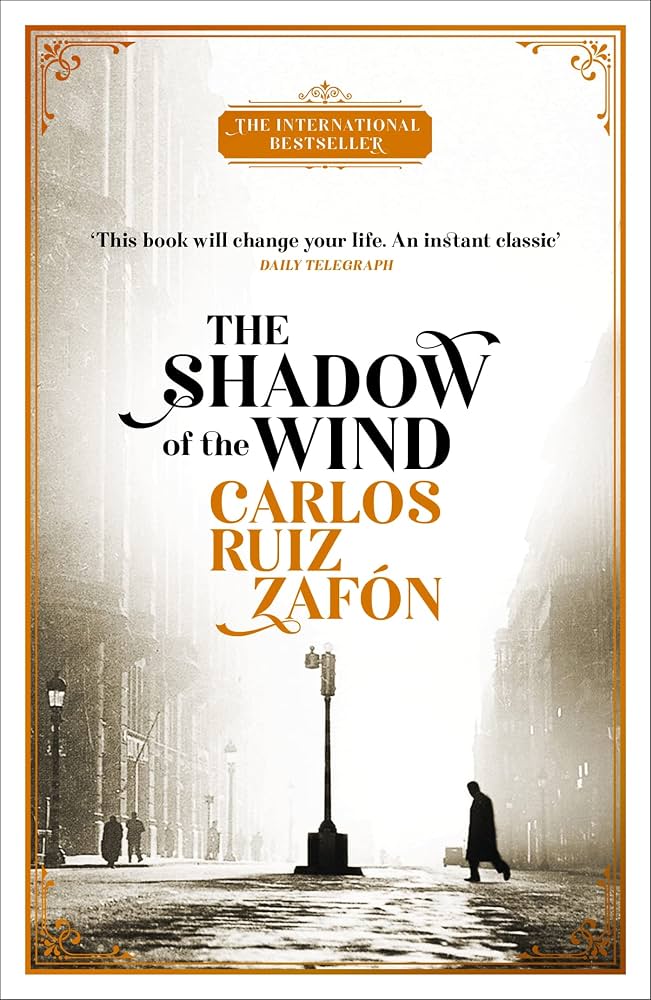
Shadow of the Wind: The Cemetery of Forgotten Books 1 by Carlos Ruiz Zafon
The first novel in The Cemetery of Forgotten Books series, the story introduces readers to Daniel Sempere, a young boy living with his father in Barcelona in 1945.
Spain is still recovering from the devastation and political consequences of the Spanish Civil War.
Against this troubled historical background, Daniel’s father, a bookseller, takes him to a mysterious hidden library known as the Cemetery of Forgotten Books.
This extraordinary place contains countless books that have been abandoned, neglected or forgotten by the world.
According to an unusual tradition, visitors who are introduced to the library must choose one book and promise to protect it throughout their lives.
Daniel selects a mysterious novel titled The Shadow of the Wind, written by an obscure author named Julián Carax.
Fascinated by the book, Daniel becomes determined to discover more about the writer.
However, his curiosity leads him into a mystery far more dangerous than he could have imagined.
He soon learns that someone has been systematically searching for and destroying every surviving copy of Carax’s books.
The mysterious figure appears to have an unsettling connection to a character from the novel itself.
As Daniel investigates the author’s past, he uncovers stories of forbidden romance, betrayal, obsession and devastating secrets.
The Shadow of the Wind by Carlos Ruiz Zafón delivers an unforgettable combination of literary mystery, historical suspense and emotional storytelling while celebrating the enduring influence of books on human lives.
The Guardian Bookshop
+1
The Cemetery of Forgotten Books – A Mysterious Literary Sanctuary
One of the most memorable elements of the novel is the Cemetery of Forgotten Books.
Hidden within the old city of Barcelona, this mysterious library contains books that have disappeared from public attention.
Its labyrinthine shelves, shadow-filled corridors and vast collection of forgotten literature create an atmosphere that feels almost magical.
The library represents the idea that every book deserves to be remembered.
For Daniel, entering the Cemetery becomes a defining moment in his life.
The tradition of selecting and protecting a forgotten book establishes a responsibility that extends far beyond ordinary reading.
Daniel’s choice connects him to the mysterious life of Julián Carax and introduces him to a world of unanswered questions.
The Cemetery also symbolises the importance of preserving stories and memories.
Throughout the novel, characters struggle with secrets, forgotten histories and events that powerful individuals would prefer to erase.
The hidden library becomes a powerful reminder that literature can preserve experiences that might otherwise disappear.
For readers who love books, libraries and literary mysteries, the Cemetery of Forgotten Books is one of the novel’s most enchanting creations.
Daniel Sempere – A Young Reader Drawn Into Mystery
Daniel Sempere is the central protagonist of The Shadow of the Wind.
At the beginning of the story, he is a young boy living with his widowed father, who operates a bookshop in Barcelona.
Daniel’s childhood is shaped by literature, family memories and the changing atmosphere of post-war Spain.
His discovery of Julián Carax’s novel awakens a curiosity that gradually becomes an obsession.
Daniel wants to understand who Carax was, why his books have disappeared and what happened to the people connected to his life.
As he grows older, his investigation becomes increasingly complicated.
He encounters individuals who possess fragments of the truth, but many are unwilling to reveal everything they know.
His determination places him in dangerous situations that challenge his understanding of loyalty, love and personal responsibility.
Daniel’s journey is also a coming-of-age story.
Through his experiences, he develops a deeper understanding of relationships, moral choices and the complicated nature of the adult world.
His growth gives the novel emotional depth beyond its central mystery.
Julián Carax – The Enigmatic Forgotten Author
Julián Carax is the mysterious writer whose disappearance forms the foundation of the novel.
Although Daniel initially knows him only through his writing, Carax gradually becomes a central presence in his life.
Information about the author is difficult to obtain.
His books have become rare, and the people who knew him appear connected by painful memories and dangerous secrets.
As Daniel searches for answers, he discovers that Carax’s past involves complicated relationships, lost opportunities and devastating consequences.
The author becomes more than simply the subject of a literary investigation.
His experiences raise questions about how love, ambition and personal choices can shape an entire lifetime.
The mystery surrounding Carax also explores the relationship between an author’s work and personal identity.
Can a writer truly disappear if their stories continue to exist?
Can destroying someone’s books erase the experiences that inspired them?
These questions give the novel its distinctive literary dimension.
Barcelona – A City of History, Secrets and Gothic Atmosphere
Barcelona plays an essential role in The Shadow of the Wind.
Carlos Ruiz Zafón transforms the city into a richly atmospheric setting filled with mysterious streets, historic buildings, forgotten corners and hidden histories.
The story unfolds in the years following the Spanish Civil War, when political repression and social uncertainty influence everyday life.
The city’s architecture becomes part of the mystery.
Daniel’s investigation takes him through bookshops, grand residences, narrow streets and locations connected to Barcelona’s complicated past.
Zafón’s descriptions create a gothic atmosphere in which the beauty of the city contrasts with the disturbing secrets concealed beneath its surface.
The historical setting also introduces important questions about memory and political power.
The experiences of individuals are shaped by larger events that have transformed Spain.
The city becomes a living presence in the narrative, preserving traces of forgotten lives and unresolved tragedies.
Readers interested in Barcelona, Spanish history and atmospheric European settings will find this aspect particularly compelling.
A Literary Mystery Filled With Dangerous Secrets
The central mystery begins with a simple question.
Who was Julián Carax?
What initially appears to be an innocent literary investigation gradually becomes a dangerous search for the truth.
Daniel discovers that Carax’s life is connected to individuals with complicated relationships and hidden motivations.
Some possess information they are unwilling to share.
Others appear determined to prevent the past from being uncovered.
The mysterious destruction of Carax’s books creates additional uncertainty.
Someone has gone to extraordinary lengths to erase the author’s literary existence.
As Daniel follows the clues, he encounters conflicting accounts and disturbing events that suggest the mystery is far more complicated than he imagined.
The investigation combines the atmosphere of gothic fiction with the suspense of a detective story.
Readers are encouraged to connect details, question appearances and consider how seemingly unrelated events might form part of a larger tragedy.
Fermín Romero de Torres – Friendship and Unexpected Wisdom
Fermín Romero de Torres is one of the novel’s most memorable supporting characters.
His unusual personality introduces humour, warmth and companionship into Daniel’s increasingly dangerous investigation.
Fermín possesses intelligence, resourcefulness and a talent for lively conversation.
His experiences have given him a complicated understanding of society and human behaviour.
Although he frequently approaches situations with humour, his personal history reflects the darker realities of Spain’s political past.
His friendship with Daniel becomes an important part of the story.
Fermín provides practical assistance, emotional support and a perspective shaped by experiences very different from Daniel’s sheltered childhood.
Their relationship demonstrates the value of loyalty and friendship during difficult circumstances.
Fermín also brings welcome moments of humour to a novel that frequently explores loss, obsession and tragedy.
Love, Obsession and the Consequences of Desire
Love is one of the novel’s central themes.
The story explores romantic attraction, loyalty, heartbreak and the difficult choices people make when relationships conflict with social expectations.
Several characters are influenced by experiences of forbidden or unfulfilled love.
Their decisions create consequences that continue affecting others long after the original events.
The novel examines the difference between genuine affection and destructive obsession.
Love can inspire courage, compassion and sacrifice.
However, it can also become connected to jealousy, resentment and a refusal to accept loss.
Through Daniel’s developing understanding of Carax’s past, the story explores how emotional experiences can influence generations.
These themes make The Shadow of the Wind both a mystery and a deeply emotional novel about human relationships.
The Spanish Civil War and Its Lasting Shadow
The historical background of the novel is essential to its atmosphere.
Set primarily in the aftermath of the Spanish Civil War, the story reflects a society affected by political repression, fear and divided loyalties.
The conflict took place between 1936 and 1939 and was followed by the dictatorship of Francisco Franco.
For many individuals, the post-war years were marked by uncertainty and the consequences of political persecution.
Zafón incorporates this troubled historical environment into the experiences of his fictional characters.
The past influences personal relationships, professional opportunities and the ability to speak openly about certain events.
Secrets are not always concealed because of private embarrassment.
Some are connected to fear, social pressure and the abuse of authority.
The novel’s historical setting adds realism and emotional significance to the gothic mystery.
Books, Memory and the Power of Storytelling
Perhaps the most important theme in The Shadow of the Wind is the power of literature.
The novel presents books as objects capable of preserving experiences, ideas and emotional connections across generations.
Daniel’s decision to protect a forgotten book becomes the beginning of a journey that changes his understanding of the world.
The mysterious destruction of Carax’s novels introduces the opposite idea.
What happens when someone attempts to erase a story from existence?
Through the contrast between preservation and destruction, Zafón explores the relationship between literature and memory.
Books can connect people who have never met.
They can preserve the voices of individuals whose lives have otherwise been forgotten.
They can also inspire readers to question their assumptions and investigate unfamiliar experiences.
This celebration of reading makes the novel especially meaningful for book lovers.
Gothic Suspense and Psychological Mystery
The Shadow of the Wind incorporates several elements associated with gothic fiction.
Mysterious figures, decaying buildings, tragic relationships and hidden histories create an atmosphere of uncertainty.
The story frequently blurs the boundary between ordinary reality and the unsettling impression that supernatural forces may be involved.
However, its mystery remains deeply connected to human motives and historical experiences.
Fear, jealousy, grief and obsession influence the characters’ decisions.
The gradual revelation of secrets creates psychological suspense as Daniel attempts to understand the events surrounding Carax’s life.
Zafón’s atmospheric descriptions contribute to a sense of danger even during apparently ordinary encounters.
The combination of gothic imagery and emotional realism gives the novel a distinctive identity.
A Coming-of-Age Story About Knowledge and Responsibility
Although the novel contains a complicated literary mystery, it is also a story about growing up.
Daniel begins his journey as a young boy fascinated by a mysterious book.
As the years pass, his investigation exposes him to experiences that challenge his understanding of adulthood.
He learns that personal relationships can be complicated by secrecy, pride and social expectations.
He also discovers that the past can exert a powerful influence on the present.
Through friendships, romantic experiences and moments of danger, Daniel begins developing his own understanding of responsibility.
His relationship with his father provides an emotional foundation for the story.
The importance of family, loyalty and compassion becomes increasingly clear as he confronts difficult situations.
The coming-of-age narrative gives the novel a personal dimension alongside its wider historical themes.
The Cemetery of Forgotten Books Series Reading Order
The Shadow of the Wind is the first published novel in Carlos Ruiz Zafón’s Cemetery of Forgotten Books series.
The publication reading order is:
- The Shadow of the Wind – Book 1
- The Angel’s Game – Book 2
- The Prisoner of Heaven – Book 3
- The Labyrinth of the Spirits – Book 4
The novels are interconnected through their settings, characters and central mysteries.
Although the books explore different perspectives and periods, reading them in publication order provides a rewarding introduction to the larger story.
The series can also be appreciated for the way its narratives gradually reveal different aspects of Barcelona’s fictional literary world.
Why Read The Shadow of the Wind?
The novel offers an unforgettable combination of mystery, literary fiction and historical storytelling.
Its central premise will immediately appeal to anyone who has experienced the pleasure of discovering a mysterious or forgotten book.
The setting of post-war Barcelona provides a beautiful yet unsettling atmosphere.
The mystery of Julián Carax creates suspense, while Daniel’s emotional development gives the novel warmth and depth.
Zafón’s storytelling combines memorable characters, romantic tragedy, humour and dangerous secrets.
Its exploration of literature and memory makes it particularly appealing to readers who enjoy books about books.
The novel is recommended for anyone seeking a richly atmospheric story with an intricate plot and strong emotional themes.
Who Should Read This Book?
The Shadow of the Wind is recommended for:
- Fans of Carlos Ruiz Zafón
- Readers who enjoy historical mystery novels
- Fans of gothic fiction and literary thrillers
- Readers interested in books about books and libraries
- Fans of atmospheric European settings
- Readers interested in post-war Barcelona
- Readers who enjoy mysterious disappearances and hidden secrets
- Fans of coming-of-age fiction
- Readers who enjoy romantic tragedy and emotional suspense
- Readers interested in Spanish literature
- Fans of historical conspiracy mysteries
- Readers who enjoy intricate plots and unexpected revelations
About the Author – Carlos Ruiz Zafón
Carlos Ruiz Zafón was an internationally bestselling Spanish author known for his atmospheric literary mysteries, gothic fiction and richly imagined stories set in Barcelona.
Born in Barcelona in 1964, he became one of Spain’s most widely read contemporary novelists.
His works include The Shadow of the Wind, The Angel’s Game, The Prisoner of Heaven and The Labyrinth of the Spirits.
He also wrote young adult novels, including The Prince of Mist and The Midnight Palace.
His writing is recognised for combining literary mystery, suspense, romance and historical atmosphere.
The Shadow of the Wind became an international bestseller and introduced millions of readers to the Cemetery of Forgotten Books.
Zafón’s novels have been translated into numerous languages and have attracted readers around the world.
He died in 2020, leaving behind a literary legacy celebrated for its imaginative storytelling and memorable characters.





Reviews
There are no reviews yet.