






Description
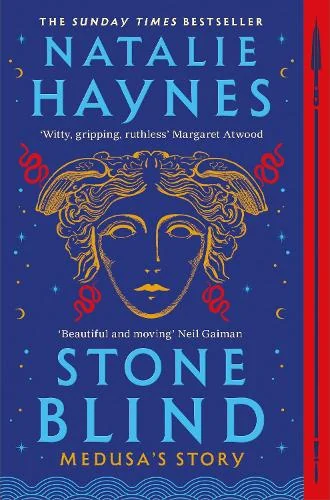
Stone Blind by Natalie Haynes
Stone Blind by Natalie Haynes
Stone Blind by Natalie Haynes is a sharp, moving and darkly funny retelling of the Greek myth of Medusa, re-examining one of mythology’s most famous monsters from perspectives often pushed aside in traditional versions of the story.
Medusa grows up surrounded by immortals.
Her sisters, Sthenno and Euryale, are Gorgons who cannot age or die, but Medusa is mortal.
She changes.
She can be hurt.
And she experiences time differently from the immortal beings around her.
Yet she is deeply loved by her sisters.
Rather than beginning with Medusa as a terrifying monster, Natalie Haynes asks readers to consider the person who existed before generations of stories reduced her to a severed head and a deadly stare.
The official publisher describes Stone Blind as the story of how a young woman became a monster—and how she was never really a monster at all.
Medusa Before the Monster
Most traditional retellings introduce Medusa through the story of Perseus.
She is the creature he must defeat.
Her head becomes a trophy.
Her ability to turn people to stone becomes a challenge for a hero to overcome.
Stone Blind changes the perspective.
Instead of asking how Perseus defeated Medusa, the novel asks:
What happened to Medusa before Perseus arrived?
Growing up with her Gorgon sisters, Medusa understands that she is different from them because she is mortal.
She is vulnerable in ways they are not.
Yet the sisters form a loving family, challenging the idea that the Gorgons should automatically be viewed as monsters simply because humans fear them.
Medusa, Poseidon and Athene
A defining moment in Medusa’s story occurs in the temple of Athene.
Poseidon commits an act of sexual violence against Medusa.
Athene responds not by punishing Poseidon but by transforming Medusa.
Snakes replace her hair.
Her gaze gains the power to turn living creatures to stone.
Her transformation creates an unbearable problem: she can no longer safely look at those she loves.
Haynes uses this part of the ancient myth to examine power, injustice, victim-blaming and the way powerful figures can avoid consequences while vulnerable people carry the punishment.
Because these themes include sexual violence and trauma, the novel is best suited to an adult/general readership.
The Gorgon Sisters
One of the most emotionally important parts of Stone Blind is the relationship between Medusa and her sisters.
Sthenno and Euryale are often treated as background creatures in versions of the Perseus myth.
Here, they become family.
Their relationship with Medusa brings tenderness into a story usually remembered for violence.
The sisters love and protect her.
This emphasis on sisterhood changes the emotional meaning of the myth.
Medusa is not an isolated monster waiting for a hero to arrive.
She is someone with a home, relationships and people who will grieve her.
Perseus Reconsidered
Perseus is traditionally presented as one of the great heroes of Greek mythology.
Stone Blind approaches heroism much more critically.
Haynes asks readers to reconsider what makes someone a hero and what happens when famous myths are told almost entirely from the perspective of victorious men.
The novel does not simply reverse the traditional story by making every hero evil and every monster good.
Instead, it questions the labels themselves.
Who gets called heroic?
Who gets called monstrous?
And who has the power to decide?
That question runs through the novel from beginning to end.
Multiple Perspectives
Although Medusa is at the emotional centre of the novel, Stone Blind is not told only from her perspective.
Haynes moves between numerous voices from mythology, allowing gods, mortals and unexpected observers to comment on events.
This gives the novel a broader view of the mythological world and allows the same event to appear very different depending on who is telling the story.
The structure also reflects one of the novel’s central ideas:
Stories change depending on whose voice we choose to hear.
Readers familiar with Greek mythology will recognise many characters and myths woven into the wider narrative, while readers who are new to mythology can still follow Medusa’s story without needing specialist knowledge.
Feminist Greek Myth Retelling
Stone Blind belongs to the modern tradition of Greek mythology retellings that re-examine familiar stories from the viewpoints of women whose experiences were minimised or ignored.
However, Natalie Haynes brings particular expertise to the subject as a classicist, writer and broadcaster.
Her approach combines detailed knowledge of the ancient sources with modern questions about:
- gender
- power
- violence
- justice
- victimhood
- heroism
- family
- storytelling
The result is both a mythological novel and a commentary on how myths are remembered.
Major Themes
Important themes in Stone Blind include:
- Medusa and the Gorgons
- sisterhood
- family
- power
- injustice
- sexual violence and its aftermath
- victim-blaming
- female rage
- mortality
- Greek mythology
- heroism
- monsters
- storytelling
- perspective
- identity
The novel repeatedly demonstrates that the words hero and monster often reveal more about the storyteller than the person being described.
Awards and Recognition
Stone Blind was longlisted for the 2023 Women’s Prize for Fiction. Pan Macmillan continues to highlight this recognition on the paperback edition.
It also became a Sunday Times bestseller, further establishing Natalie Haynes as one of the best-known contemporary writers reimagining Greek myth.
Is Stone Blind Part of a Series?
No.
Stone Blind is a standalone novel.
It is not a numbered sequel to A Thousand Ships, The Children of Jocasta or Haynes’s other mythology books.
These books share an interest in Greek myth and overlooked female perspectives, but they can be read independently.
For WooCommerce use:
Series: Standalone
Book Number: Standalone
Who Should Read Stone Blind?
This book is especially suitable for adult readers who enjoy:
- Greek mythology retellings
- feminist fiction
- historical fantasy
- literary fiction
- Medusa retellings
- books about ancient Greece
- morally complex characters
- mythology from women’s perspectives
- Madeline Miller-style mythological fiction
- Natalie Haynes books
- stories about sisterhood
- re-examinations of traditional heroes
Readers who enjoyed novels such as Circe, A Thousand Ships or other modern Greek-myth retellings may find Stone Blind particularly appealing.
About Natalie Haynes
Natalie Haynes is a writer, broadcaster and classicist known for bringing ancient Greek and Roman stories to contemporary audiences.
Her books include:
- A Thousand Ships
- The Children of Jocasta
- Stone Blind
- Pandora’s Jar
- Divine Might
- No Friend to This House
Her novel A Thousand Ships was shortlisted for the Women’s Prize for Fiction, and her work combines classical scholarship with accessible, inventive storytelling.
For customers looking to buy Stone Blind by Natalie Haynes in Sri Lanka, ISBN 9781529061512 is the UK Picador paperback edition and the strongest match for imported international bookstore stock.




Reviews
There are no reviews yet.