






Description
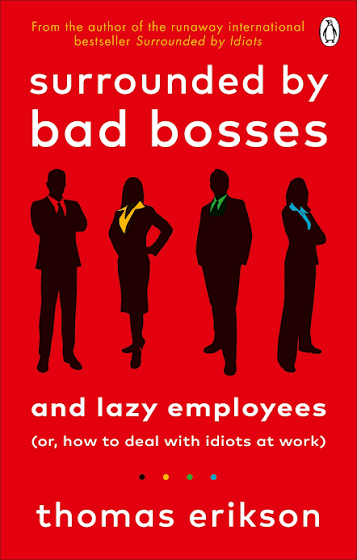
Surrounded by Bad Bosses (And Lazy Employees) by Thomas Erikson
Surrounded by Bad Bosses by Thomas Erikson
Surrounded by Bad Bosses (And Lazy Employees) by Thomas Erikson is a practical workplace communication and leadership book for anyone who has ever struggled with an irritating manager, unmotivated employee, confusing colleague or dysfunctional team.
Maybe your boss never explains what they want.
Maybe they change their mind constantly.
Perhaps they micromanage everything you do.
Or they avoid difficult decisions and expect everyone else to solve their problems.
Sometimes the situation is reversed.
You may be the manager wondering why certain employees consistently misunderstand instructions, resist change, miss deadlines or seem impossible to motivate.
Thomas Erikson argues that many of these workplace frustrations arise because people communicate, make decisions and respond to pressure in very different ways.
Using the same simplified four-colour behaviour framework popularised in Surrounded by Idiots, Erikson examines how employees can adapt to different management styles—and how managers can better understand the people working for them. Macmillan describes the book as applying his behavioural framework specifically to workplace leadership and communication.
Why Are There So Many Bad Bosses?
The first part of the book looks at life from the employee’s perspective.
Bad management can take many forms.
A boss may be highly controlling.
Another may be too passive.
Some managers communicate constantly but never clearly.
Others provide almost no information and expect employees to somehow know what to do.
Erikson asks readers to look beyond simply deciding that a boss is “difficult.”
Instead, he encourages them to examine how that person communicates and what motivates their behaviour.
According to the book, recognising these patterns can make it easier to adapt your own communication and reduce unnecessary conflict.
The Four-Colour Behaviour Model
Readers familiar with Surrounded by Idiots will recognise Erikson’s colour system.
He uses four colours as shorthand for broad communication styles.
Red represents people who tend to be direct, decisive and results-focused.
Yellow is associated with enthusiasm, sociability and persuasion.
Green describes a calmer, patient and relationship-oriented style.
Blue represents analytical, detail-focused and structured behaviour.
In Surrounded by Bad Bosses, Erikson applies these categories to workplace situations.
For example, a highly direct employee may become frustrated with a manager who takes a long time to reach decisions.
A detail-focused employee may struggle when working for someone who gives vague instructions.
A highly social manager may overwhelm an employee who prefers quiet structure.
The book’s purpose is to help readers recognise such differences and adjust communication accordingly.
It is worth treating the four-colour system as a simplified communication framework rather than a clinical or scientifically diagnostic personality test.
How to Communicate With Your Boss
A major theme of the book is adaptation.
You cannot always change your manager.
You may not even be able to change your workplace immediately.
But you can sometimes improve a difficult professional relationship by changing how information is presented.
A results-focused boss may prefer:
brief explanations,
clear outcomes,
and quick decisions.
A detail-oriented boss might prefer:
evidence,
specific numbers,
carefully organised information,
and enough time to examine a proposal.
Understanding these differences can reduce the feeling that another person is intentionally being difficult when they may simply have a very different communication style.
Leadership Is Communication
Erikson also emphasises that leadership is strongly connected to communication.
A manager may have excellent technical knowledge yet still struggle to lead a team.
Knowing how to do the work is not the same as knowing how to:
give useful instructions,
provide feedback,
resolve disagreements,
motivate different personalities,
delegate responsibility,
or communicate expectations.
The book therefore asks readers to think about management not simply as authority but as the ability to communicate effectively with people who do not necessarily think in the same way.
The book’s contents specifically include sections on leadership as communication, recognising a boss’s behavioural style, workplace stress, motivation and adapting to different personalities.
What If the Boss Isn’t the Problem?
This is where the second half of the book changes direction.
It is easy to complain about management.
But what if the manager is not always responsible?
The complete title includes And Lazy Employees for a reason.
Erikson turns the discussion around and examines workplace problems from the manager’s perspective.
Some employees consistently underperform.
Some resist responsibility.
Others require constant supervision.
And sometimes people blame management without examining their own habits.
Macmillan explains that the book deliberately includes both perspectives: how employees can deal with difficult managers and how managers can address employees who frequently underachieve.
Are You a Difficult Employee?
One of the useful aspects of the book is that it encourages self-reflection.
It is comfortable to identify flaws in other people.
It is harder to ask whether your own communication creates problems.
Do you explain clearly what you need?
Do you adapt when speaking to someone with a different working style?
Do you accept feedback?
Do you understand why your boss prioritises certain tasks?
Could your own behaviour be contributing to the conflict?
By switching perspectives between employee and manager, Erikson encourages readers to examine both sides of workplace relationships.
Different Employees Need Different Leadership
A management style that motivates one person may frustrate another.
One employee may want independence.
Another may prefer frequent guidance.
One may enjoy rapid change.
Another may perform better with predictable routines.
Someone may respond strongly to public recognition, while another prefers private feedback.
Erikson argues that effective managers should recognise these differences rather than assuming everyone should be managed exactly the same way.
This does not mean abandoning standards.
It means changing how those standards are communicated and supported.
Workplace Stress and Misunderstandings
The book also looks at stress.
Different behavioural styles may respond to pressure in very different ways.
Under stress, a direct person may become even more forceful.
A highly social person might become disorganised.
A cautious person might become resistant to sudden change.
A detail-oriented person might become overly focused on accuracy.
Understanding these tendencies can make it easier to recognise when workplace conflict is being intensified by stress rather than by deliberate hostility.
Useful for Employees and Managers
One reason Surrounded by Bad Bosses stands out from many leadership books is that it does not speak exclusively to senior executives.
It is written for people on both sides of management relationships.
Employees can use it to think about communicating upward.
Managers can use it to think about communicating downward.
Team leaders can use it when resolving differences among colleagues.
And readers preparing for management roles can use it to consider how their natural communication preferences may affect other people.
Publishers Weekly highlighted this dual employee-and-manager perspective as a distinguishing aspect of the book.
Part of the Surrounded by Idiots Series
The book belongs to Thomas Erikson’s Surrounded by Idiots series.
Readers who already know the colour framework from Surrounded by Idiots can move directly into its workplace application here.
Related books include titles such as:
Surrounded by Idiots
Surrounded by Psychopaths
Surrounded by Narcissists
Surrounded by Energy Vampires
Surrounded by Liars
Surrounded by Bad Bosses is particularly relevant to readers interested in management, workplace psychology, leadership and communication. Macmillan officially identifies it as part of the Surrounded by Idiots series.
Why Read Surrounded by Bad Bosses?
This book is suitable for readers who want to understand difficult workplace relationships without relying only on blame.
It may be particularly useful for:
employees struggling with managers,
new supervisors,
team leaders,
business owners,
HR professionals,
project managers,
and anyone interested in improving workplace communication.
The central lesson is straightforward:
People do not all communicate, respond to pressure or approach work in the same way.
Recognising those differences may not magically transform a terrible workplace, but it can give you additional tools for navigating difficult professional situations.
About Thomas Erikson
Thomas Erikson is a Swedish author, lecturer and behavioural communication writer best known for Surrounded by Idiots. Macmillan describes him as an internationally bestselling author who has spent many years delivering seminars and lectures to executives and managers at major organisations.
With humour, examples and workplace scenarios, Surrounded by Bad Bosses (And Lazy Employees) extends his communication framework into the world of managers, employees and everyday professional conflict.





Reviews
There are no reviews yet.