

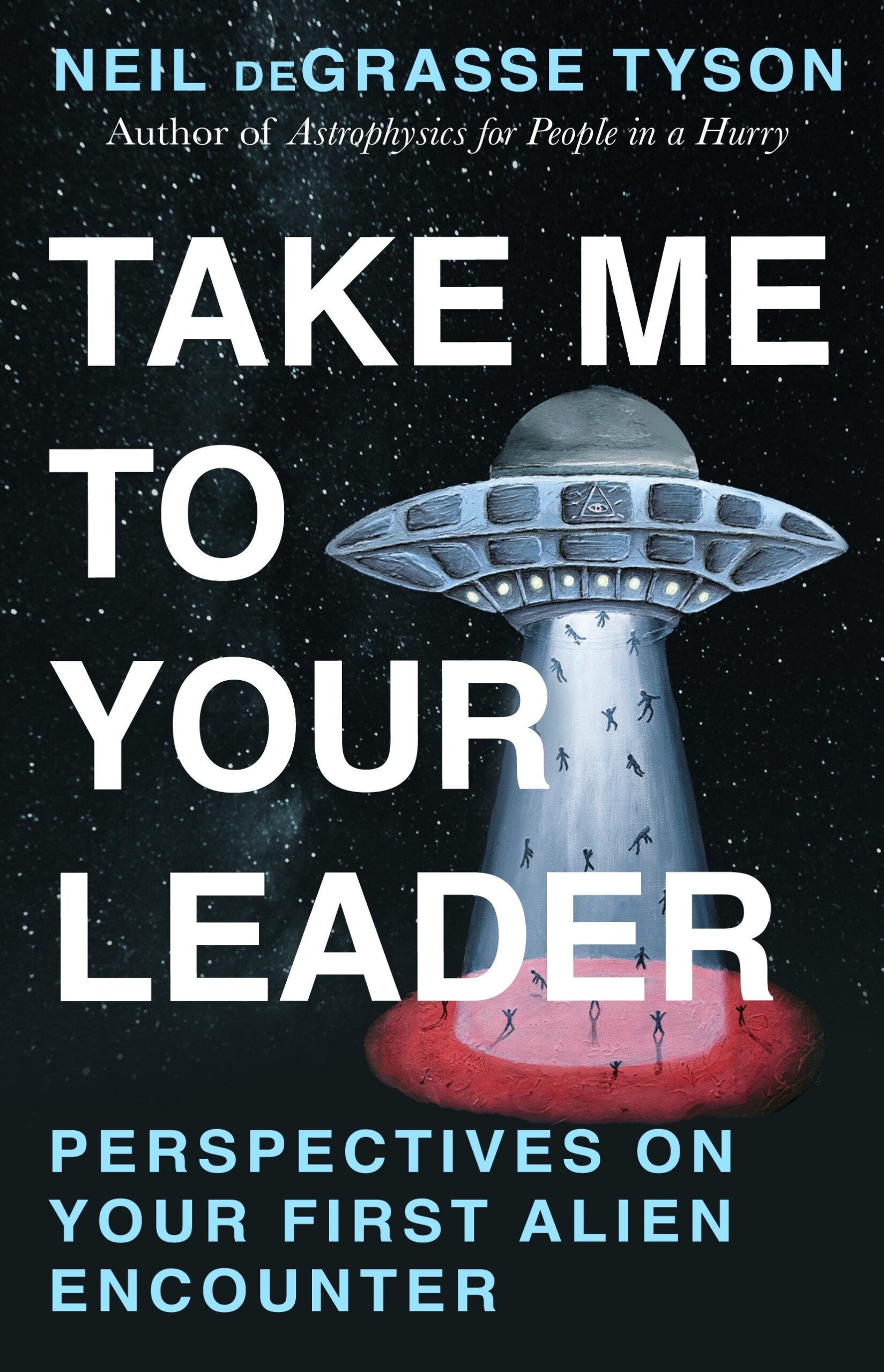





Description
Take Me to Your Leader: Perspectives on Your First Alien Encounter by Neil deGrasse Tyson
Take Me to Your Leader by Neil deGrasse Tyson
Take Me to Your Leader by Neil deGrasse Tyson is an entertaining popular-science exploration of one of humanity’s biggest questions:
Are we alone in the universe?
And if the answer is no, what might happen if extraterrestrial visitors actually arrived on Earth?
Rather than treating aliens simply as science-fiction entertainment, Tyson combines astrophysics, history, popular culture and humour to examine what an encounter with extraterrestrial intelligence might realistically involve.
Simon & Schuster describes the book as both a practical guide to meeting alien visitors and a cultural history of humanity’s long fascination with extraterrestrial life.
What Might an Alien Actually Look Like?
Movies have trained us to imagine aliens in familiar forms.
Two arms.
Two legs.
A head.
Large eyes.
Perhaps green or grey skin.
But evolution on another planet would not necessarily produce anything that resembles a human being.
Tyson uses physics and biology to explore the kinds of environments in which extraterrestrial life might evolve and asks whether alien organisms could have entirely unfamiliar shapes, senses or methods of movement.
His official book description specifically notes that he considers what aliens might look like and how they might behave while applying universal physical laws to the possibilities.
How Would Aliens Reach Earth?
Finding life somewhere else in the universe and having that life actually visit Earth are very different problems.
The distances between stars are enormous.
Even the nearest star systems are separated from us by distances that make ordinary travel extremely difficult.
Tyson therefore considers questions such as:
How fast could an advanced spacecraft realistically travel?
What physical limits would it face?
How much energy would interstellar travel require?
Could an extraterrestrial civilisation have technologies far beyond anything humans currently possess?
The book uses these questions to separate the exciting possibilities of first contact from the physical challenges imposed by the universe.
UFOs, UAPs and Alien Visitors
The book also explores humanity’s fascination with UFOs and UAPs—unidentified anomalous phenomena.
People have reported strange objects in the sky for generations.
But “unidentified” does not automatically mean “extraterrestrial.”
Tyson approaches the subject from a scientific perspective, examining why unusual observations occur and what kind of evidence would actually be necessary before scientists could conclude that an object originated from another world.
Simon & Schuster specifically describes the book as addressing questions about the large number of UFO reports and whether extraterrestrials could already be among us.
A Scientific Look at First Contact
Suppose an alien spacecraft really did arrive.
What should humanity do?
Who should speak first?
Scientists?
Political leaders?
Military officials?
The United Nations?
And if the visitor used the classic science-fiction phrase:
“Take me to your leader.”
Who exactly would qualify as Earth’s leader?
Human civilisation has no single global ruler.
That simple problem allows Tyson to mix science with observations about politics, culture and the unusual way our species organises itself.
How Would We Communicate?
Language could become one of the greatest challenges of first contact.
An extraterrestrial visitor would have no reason to speak English—or any human language.
Even concepts that seem universal to us might not be communicated in familiar ways.
Could mathematics provide common ground?
Could geometry help?
Would physics become the closest thing to a universal language?
Tyson explores questions like these while connecting scientific concepts to the practical difficulties of communicating with a completely unfamiliar intelligence. The UK description specifically raises communication and the possible relevance of mathematical ideas such as the Pythagorean theorem.
Aliens in Movies and Popular Culture
Part of the fun of Take Me to Your Leader comes from comparing scientific possibilities with the aliens humans have imagined.
For decades, books, films and television have given us:
alien invasions,
flying saucers,
abductions,
Area 51,
friendly extraterrestrials,
hostile extraterrestrials,
and countless versions of first contact.
Tyson draws on depictions from history, literature, film and popular culture and compares them with what the laws of physics might actually permit.
The book therefore works not only as astronomy but also as a playful examination of how humans imagine the unknown.
Why Haven’t Aliens Contacted Us?
One of the great questions surrounding extraterrestrial life is simple:
If intelligent life exists elsewhere, why haven’t we clearly detected it?
There are many possible explanations.
Civilisations could be rare.
They might exist too far away.
Technological societies might survive only briefly.
Their communication methods might be completely different from ours.
Or humanity may simply not have been searching for long enough.
Tyson considers such questions without presenting speculation as confirmed evidence.
That scientific distinction matters: the possibility of extraterrestrial life is a legitimate scientific question, but there is currently no scientifically confirmed evidence that alien visitors have reached Earth.
What Would Aliens Think of Us?
Perhaps one of the funniest and most uncomfortable questions in the book is not what humans would think of aliens.
It is:
What would aliens think of humans?
Imagine an advanced civilisation examining Earth.
They might see remarkable scientific achievements.
Art.
Mathematics.
Space exploration.
Medicine.
Music.
But they would also see conflict, environmental problems and a species divided into hundreds of nations that cannot agree on a single planetary leader.
Tyson uses the imagined outsider’s perspective as a way of examining humanity itself.
Science With Neil deGrasse Tyson’s Humour
Readers familiar with Astrophysics for People in a Hurry or the StarTalk podcast will recognise Tyson’s conversational approach.
Complex scientific ideas are mixed with humour, cultural references and questions designed to make readers curious rather than intimidated.
Simon & Schuster describes the book as a combination of scientific information and entertainment, while Space praised its mixture of science, pop culture, history and humour.
That makes the book suitable even for readers who do not normally read technical astronomy books.
A Pocket-Sized Popular Science Book
At 240 pages, Take Me to Your Leader is relatively compact.
Instead of functioning as a university textbook on astrobiology, it offers an accessible tour through the biggest questions surrounding aliens and first contact.
Topics include:
- Extraterrestrial life
- Astrophysics
- Interstellar travel
- UFOs and UAPs
- Alien biology
- First-contact communication
- Popular culture
- Humanity’s place in the universe
Simon & Schuster currently lists the hardcover at 240 pages.
Why Read Take Me to Your Leader?
This book is especially suitable for readers interested in:
- Astronomy
- Astrophysics
- Aliens and extraterrestrial life
- Space exploration
- UFO and UAP discussions
- Popular science
- Science fiction culture
- Neil deGrasse Tyson
- The search for life beyond Earth
The appeal is not that Tyson claims to know exactly what aliens will look like.
It is that he asks what science can reasonably tell us—and where speculation begins.
That distinction turns a familiar science-fiction idea into a fascinating exercise in scientific thinking.
About Neil deGrasse Tyson
Neil deGrasse Tyson is an astrophysicist, author and science communicator. He is director of the Hayden Planetarium at the American Museum of Natural History and host and cofounder of the StarTalk podcast. His books include Astrophysics for People in a Hurry, Starry Messenger, Cosmic Queries and Merlin’s Tour of the Universe. Simon & Schuster also notes that he has received the National Academy of Sciences’ Public Welfare Medal and NASA’s Distinguished Public Service Medal.
Take Me to Your Leader combines Tyson’s interest in astronomy with humanity’s enduring fascination with aliens, creating an amusing and accessible book about what could become the most extraordinary encounter in human history.






Reviews
There are no reviews yet.