








Description
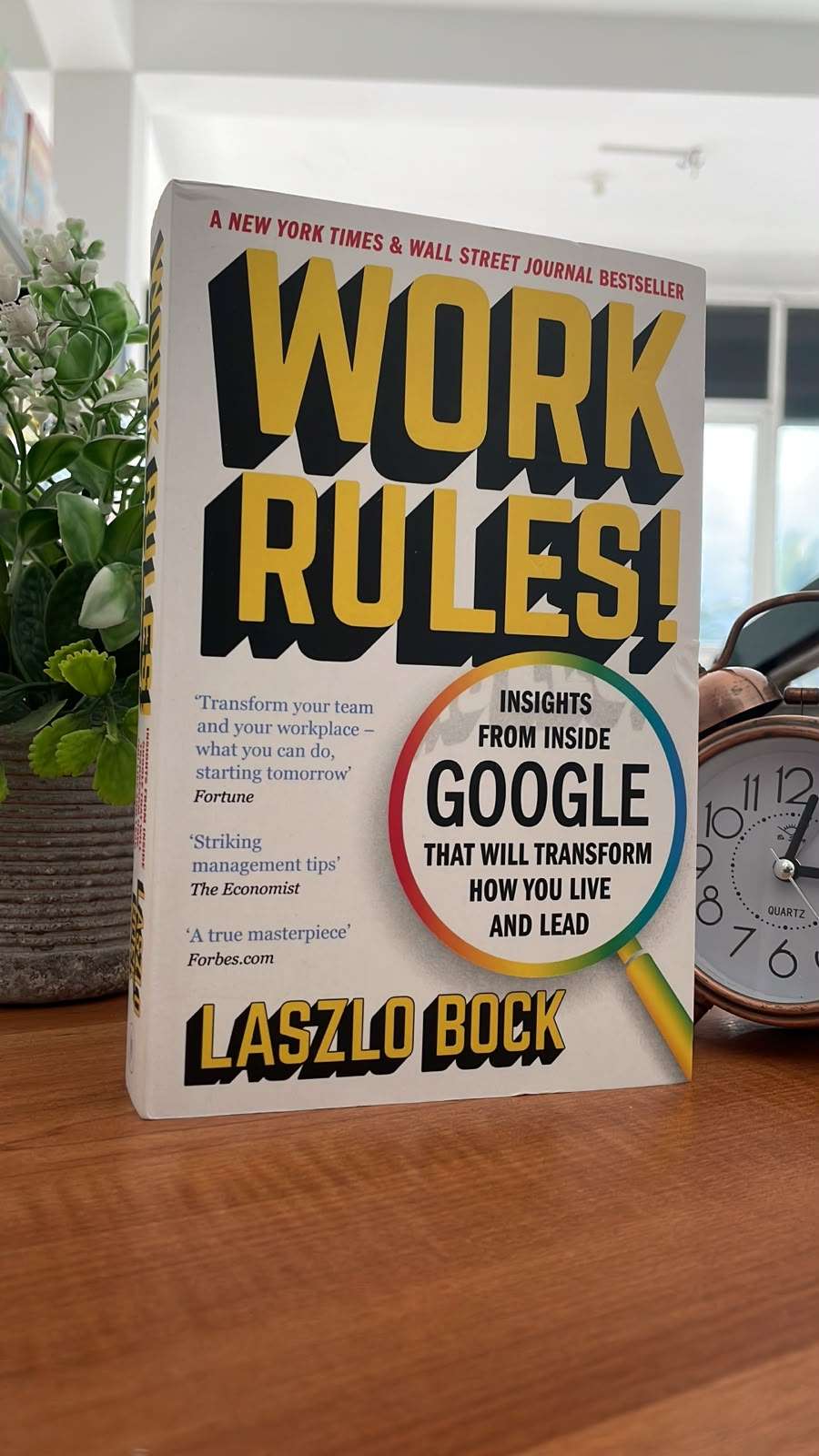
Work Rules! by Laszlo Bock
Work Rules!: Insights from Inside Google That Will Transform How You Live and Lead by Laszlo Bock is an evidence-based guide to building a workplace where talented people can perform exceptional work without being treated as replaceable resources.
Drawing on his experience leading Google’s People Operations function, Bock explains how the company approached recruitment, management, employee freedom, performance, compensation, learning, and workplace culture during a period of extraordinary growth.
The book combines stories from inside Google with research from psychology, behavioural economics, management, and other organisations. Its central argument is straightforward: treating employees well is not opposed to strong business performance. When people are trusted, given meaningful work, and supported by well-designed systems, both employees and organisations can succeed.
Why Work Needs New Rules
Many organisations claim that people are their most valuable asset while managing them through rigid control, limited information, and processes built around distrust.
Bock argues that this contradiction damages motivation and prevents organisations from benefiting fully from their employees’ abilities. People spend a large part of their lives at work, so workplaces should offer more than a salary and a list of instructions.
A better organisation should help employees experience:
- Meaning in their work
- Trust from managers
- Fair and evidence-based decisions
- Opportunities to learn
- Freedom to contribute ideas
- Clear expectations
- Respect and dignity
- Recognition for genuine performance
- A connection with the organisation’s mission
Creating such a workplace requires more than attractive offices or employee benefits. It depends on how leaders hire, communicate, evaluate, reward, and share authority.
Give Your Work Meaning
One of the first principles in Work Rules! is that people are more motivated when they understand why their work matters.
A meaningful mission can connect routine tasks with a wider purpose. Employees are more likely to take ownership when they can see how their work contributes to customers, communities, or an important organisational goal.
Bock encourages leaders to explain:
- Whom the organisation serves
- What problem it solves
- Why the work matters
- How each team contributes
- What success will improve for other people
Meaning cannot be created only through motivational slogans. Employees must be able to connect daily decisions and responsibilities with the stated mission.
Trust Employees with Freedom
Traditional management often assumes that employees must be closely monitored or they will avoid responsibility. Bock challenges this assumption.
He argues that organisations can give people more freedom while still maintaining high expectations. Trust may involve sharing information, allowing employees to question decisions, providing flexibility, and giving teams authority over how they achieve agreed results.
Freedom does not mean the absence of accountability. It means giving responsible people room to exercise judgement.
A high-freedom workplace may encourage employees to:
- Speak openly about problems
- Challenge senior leaders
- Suggest improvements
- Experiment with new approaches
- Organise work effectively
- Make decisions close to the customer
- Share information across teams
- Take responsibility for outcomes
When leaders trust employees, they must also be willing to accept that not every experiment will succeed.
Hire People Better Than You
Recruitment receives significant attention in Work Rules! because hiring decisions influence an organisation for many years.
Bock argues that managers should seek candidates who strengthen the organisation rather than selecting people who simply resemble the existing team. A manager should not feel threatened by hiring someone with stronger skills in a particular area.
The book examines Google’s use of structured hiring practices, including clearly defined criteria, multiple interviewers, work-related questions, independent review, and evidence-based evaluation.
Useful hiring principles include:
- Maintain high standards even when a vacancy is urgent.
- Define the role before interviewing candidates.
- Ask consistent, structured questions.
- Evaluate evidence rather than intuition alone.
- Use multiple perspectives.
- Separate hiring quality from a manager’s immediate staffing pressure.
- Avoid relying heavily on unstructured interviews.
- Treat candidates respectfully throughout the process.
Hiring fewer exceptional people may create better long-term results than filling positions rapidly with poorly matched candidates.
Why Unstructured Interviews Can Mislead
A friendly conversation can make an interviewer feel confident about a candidate, but that confidence may not predict future performance.
Interviewers are vulnerable to first impressions, similarity bias, confirmation bias, and personal preference. Once they form an early opinion, they may interpret later answers in ways that support it.
Bock recommends structured interviews in which candidates are asked comparable questions and assessed against predefined criteria. Questions should encourage applicants to describe specific past behaviour or solve problems relevant to the role.
This approach does not eliminate human judgement, but it makes decisions more consistent and easier to review.
Use Data Without Forgetting People
Google applied analytical methods to workplace questions through its People Analytics teams. Instead of relying entirely on management traditions or assumptions, the company tested ideas using evidence.
Questions might include:
- Which interview methods predict performance?
- What behaviours distinguish effective managers?
- Why do employees leave?
- Which training programmes improve results?
- How do physical spaces influence collaboration?
- What creates employee satisfaction?
- Which benefits are genuinely valuable?
Bock shows that people decisions can be examined with data, but he does not suggest reducing employees to numbers. Quantitative information should be combined with context, judgement, and respect for individual experience.
Learning from the Best and the Worst
Many organisations study only their highest-performing employees. Bock recommends examining both ends of the performance distribution.
Top performers may reveal habits, skills, or working conditions that can be shared with others. Employees who are struggling may identify unclear expectations, unsuitable roles, weak management, missing training, or problems in the organisation’s systems.
Before removing a low performer, a manager should ask whether that person could succeed with:
- Clearer feedback
- Better training
- A different role
- Improved tools
- Stronger support
- More suitable responsibilities
- A different manager or team
Not every performance problem can be solved, but treating dismissal as the only response may waste talent and prevent the organisation from learning.
Managers Should Serve Their Teams
The book questions the traditional idea that authority should flow only from the top. A manager’s role is not merely to issue instructions and evaluate employees.
Effective managers remove obstacles, provide context, coach people, communicate expectations, and help their teams succeed.
Research discussed in the book identifies behaviours associated with effective management, such as:
- Providing useful coaching
- Avoiding unnecessary micromanagement
- Showing concern for employees
- Communicating clearly
- Supporting career development
- Maintaining a clear team vision
- Possessing relevant knowledge
- Making sound decisions
- Listening to feedback
Importantly, Bock argues that management quality can improve when organisations define good behaviours, measure them, and provide targeted coaching.
Rethinking Performance Management
Traditional annual performance reviews often combine several different purposes: feedback, development, promotion, compensation, and documentation.
This can make honest conversation difficult. When employees know that every comment may affect their salary or promotion, they may become defensive rather than focusing on improvement.
Bock discusses the value of separating developmental conversations from reward decisions. Feedback should happen regularly and should be specific enough to guide action.
Useful feedback explains:
- What happened
- Why it mattered
- Which behaviour contributed to the result
- What should continue
- What needs to change
- What support is available
- When progress will be reviewed
The purpose should be to improve future performance, not merely assign a label to past work.
Pay Unfairly—but Explain Why
One of the book’s most provocative ideas is that organisations should not automatically pay everyone in similar roles exactly the same amount.
Bock argues that individual contribution can vary significantly, and exceptional performance may justify greater rewards. Treating unequal contributions as though they are identical can appear fair while actually discouraging outstanding work.
However, differentiated compensation creates risks. Decisions must be based on credible evidence and protected against bias, favouritism, or arbitrary management preferences.
Organisations also need to explain the principles behind compensation clearly. Secrecy and unexplained differences can damage trust even when the original decision was reasonable.
Make Learning Part of Work
Training programmes often provide information without producing lasting behavioural change. Employees attend a course, return to work, and continue using the same habits.
Effective learning should focus on specific skills and include repeated practice, feedback, and opportunities for application.
Bock encourages organisations to use internal experts as teachers. High-performing employees can share practical knowledge while strengthening the culture of learning.
Training becomes more useful when it:
- Addresses a clearly defined skill
- Includes active practice
- Provides immediate feedback
- Occurs close to the real work
- Is repeated over time
- Measures behavioural change
- Allows employees to teach others
Learning should be treated as an ongoing process rather than an occasional event.
Nudges and Small Environmental Changes
Large policy changes are not always necessary to improve behaviour. Small changes in how choices are presented can influence decisions while preserving personal freedom.
These interventions, often called nudges, might involve changing default options, simplifying information, providing timely reminders, or making a desirable behaviour easier.
For example, an organisation might redesign a form, adjust the placement of healthier food, or send managers a reminder before an important employee conversation.
Bock shows how behavioural insights can improve workplace systems without depending entirely on rules and punishment.
Admit Mistakes and Keep Experimenting
The book does not claim that every Google practice succeeded. Bock discusses experiments that produced disappointing or unexpected results.
This honesty supports one of the book’s main lessons: workplace policies should be treated as testable ideas rather than permanent truths.
Leaders can:
- Begin with a small pilot
- Define the expected result
- Measure the outcome
- Ask employees for feedback
- Compare results with a suitable baseline
- Revise the programme
- Stop initiatives that do not work
- Expand successful experiments carefully
A culture of experimentation allows organisations to improve without pretending that leaders already possess every answer.
Can These Ideas Work Outside Google?
Google’s wealth, reputation, technology, and access to talent make it different from most organisations. A small retailer, public institution, non-profit organisation, or growing company cannot reproduce every benefit or programme described in the book.
However, many principles do not require an enormous budget. Leaders can still:
- Explain the meaning behind the work
- Improve interview structure
- Share more information
- Ask employees for ideas
- Provide regular feedback
- Define effective management behaviours
- Experiment with small changes
- Treat people with greater trust
- Examine workplace decisions using evidence
The most useful approach is to adapt the principles rather than imitate Google’s practices without considering context.
About Laszlo Bock
Laszlo Bock is a business leader and workplace-management expert who served as Google’s Senior Vice President of People Operations. During his tenure, Google expanded significantly while receiving international recognition for its workplace culture.
His experience combined human-resources leadership with an emphasis on behavioural science, experimentation, and data-informed decision-making.
In Work Rules!, Bock translates those experiences into practical ideas for leaders, managers, HR professionals, and employees who want to create healthier and more effective workplaces.
Who Should Read Work Rules!?
This book is suitable for:
- Business owners
- Managers and team leaders
- Human-resources professionals
- Recruiters
- Entrepreneurs and founders
- Organisational-development specialists
- Employees preparing for leadership roles
- Business and management students
- Professionals interested in workplace culture
- Leaders managing growing organisations
Book Links
Search for Work Rules! by Laszlo Bock at Book Lounge Sri Lanka:
Work Rules! – Book Lounge Search
A Blueprint for a Better Workplace
Work Rules! by Laszlo Bock challenges leaders to create organisations where freedom, evidence, fairness, and high expectations operate together.
Its lessons go beyond Google’s famous offices and employee benefits. The book focuses on the systems underneath the culture: careful hiring, meaningful work, structured evaluation, transparent leadership, continuous learning, and a willingness to test assumptions.
For anyone responsible for hiring, managing, or developing people, Work Rules! offers practical ideas for building a workplace that produces strong results while allowing employees to experience greater trust, dignity, and purpose.





Reviews
There are no reviews yet.