






Description
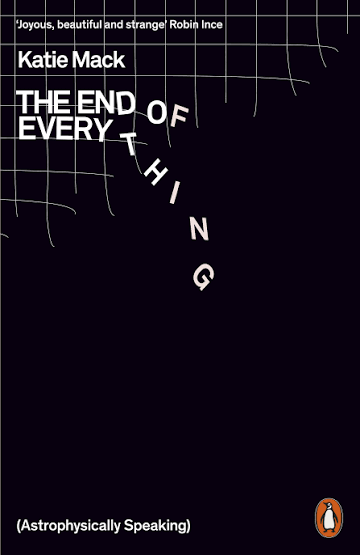
The End of Everything (Astrophysically Speaking) by Katie Mack
The End of Everything by Katie Mack
The End of Everything (Astrophysically Speaking) by Katie Mack takes one of the biggest questions imaginable and turns it into an entertaining journey through modern physics:
How will the universe end?
Human beings have always wondered about beginnings.
Where did everything come from?
How did the universe form?
What happened during the Big Bang?
But Katie Mack turns the telescope in the opposite direction.
Instead of asking where the universe came from, she asks:
Where is everything going?
Drawing on cosmology, particle physics, quantum mechanics and modern astronomical observations, Mack explores five scientifically discussed possibilities for the ultimate fate of the cosmos: the Big Crunch, Heat Death, the Big Rip, Vacuum Decay and the Bounce. Google Books
From the Big Bang to the End
Before considering how everything might end, readers first need to understand where the universe is now.
The cosmos began in an extremely hot, dense state and has been expanding for billions of years.
Galaxies formed.
Stars were born.
Planets appeared.
Eventually, on at least one small planet, life developed that became capable of asking questions about the universe itself.
The future depends partly on how that cosmic expansion behaves.
Does expansion continue forever?
Does it slow?
Does it accelerate?
Could it reverse?
And could the fundamental laws of physics themselves change the universe in a way we would never see coming?
Mack introduces these ideas without assuming that readers have advanced training in physics. Penguin describes the book as an accessible exploration of how relatively small differences in our understanding of reality can lead to very different cosmic futures. Penguin
Five Possible Endings of the Universe
1. The Big Crunch
One possibility is that the universe’s expansion could eventually reverse.
Gravity would begin pulling everything back together.
Galaxies would move toward one another.
Matter would become increasingly compressed.
Eventually, the universe could collapse toward an extremely dense final state.
This hypothetical ending is known as the Big Crunch.
It resembles the Big Bang in reverse: rather than everything expanding outward from a dense beginning, everything falls inward toward a dense ending.
Mack uses this scenario to explain how gravity, expansion and the overall contents of the universe influence its future. The Big Crunch is one of the five main scenarios specifically covered in the book. Google Books
2. Heat Death
Perhaps the least dramatic-sounding possibility may ultimately be one of the most profound.
If the universe continues expanding for an unimaginably long time, usable energy could become increasingly spread out.
Stars would eventually stop forming.
Existing stars would die.
Galaxies would grow darker.
Over immense spans of time, the universe could approach a state in which there is no longer enough usable energy available to sustain complex processes.
This is commonly called Heat Death.
The phrase does not mean everything becomes extremely hot. It refers to the universe approaching thermodynamic equilibrium, where energy differences that can perform useful work have essentially disappeared.
Mack uses this scenario to introduce readers to ideas such as entropy, thermodynamics and the arrow of time.
3. The Big Rip
The expansion of the universe is currently accelerating, a discovery linked to what physicists call dark energy.
But what if that acceleration became increasingly powerful?
In the Big Rip scenario, expansion could eventually become strong enough to overcome the forces holding structures together.
Large cosmic structures would separate first.
Then galaxies.
Potentially stars and planets.
In extreme versions of the scenario, even smaller bound structures could eventually be torn apart.
It is one of the book’s more spectacular possibilities and provides Mack with an opportunity to explain what scientists know—and still do not know—about dark energy. Kirkus Reviews
4. Vacuum Decay
Among the strangest endings discussed in the book is Vacuum Decay.
Modern particle physics raises the possibility that what we consider the stable vacuum state of our universe might not be the lowest-energy state possible.
If our universe exists in a metastable state, a transition to a lower-energy state could theoretically begin somewhere in the cosmos and spread outward.
The consequences would fundamentally alter the physics inside the expanding region.
And there could be no advance warning.
Mack’s discussions of Vacuum Decay involve concepts connected to quantum physics and the Higgs field, illustrating how seemingly abstract particle physics can have implications for the fate of the entire universe. Kirkus Reviews
5. The Bounce
Then there is the possibility that an apparent ending might lead to another beginning.
A Bounce scenario imagines that a contracting or otherwise transforming universe could transition into a new expanding phase rather than ending permanently.
Such ideas raise extraordinary questions.
Could the cosmos operate in cycles?
Could one universe lead to another?
Could something exist before what we call the Big Bang?
These possibilities remain theoretical, but they give physicists ways to investigate some of the deepest problems in cosmology.
The Bounce completes Mack’s tour of the five principal endings explored in the book. Google Books
Complex Science Without Becoming a Textbook
One of the book’s strengths is that it deals with serious scientific concepts without reading like an academic physics textbook.
Mack discusses topics including:
- Cosmology
- Quantum mechanics
- Dark matter
- Dark energy
- Entropy
- The Higgs field
- String theory
- Black holes
- Cosmic expansion
- The early universe
- The possible ultimate fate of reality
Yet the presentation is designed for general readers.
Reviews highlighted by Penguin praise the book’s ability to make difficult ideas approachable while retaining humour and scientific substance. Penguin
Surprisingly Funny for a Book About Cosmic Doom
A book about the destruction of absolutely everything might sound depressing.
Mack takes a different approach.
Her writing uses humour, cultural references and relatable comparisons to explain difficult concepts.
The result is less like being lectured about cosmic disaster and more like listening to an enthusiastic astrophysicist explain why the universe is stranger than most science fiction.
Kirkus similarly noted that Mack’s treatment of the end of the universe remains entertaining while exploring topics such as dark energy, the Higgs boson and the multiverse. Kirkus Reviews
What Can Scientists Actually Know?
A major theme is the distinction between evidence and speculation.
Scientists cannot simply travel billions or trillions of years into the future and observe the end of the universe.
Instead, they use:
observations of the present universe,
measurements of cosmic expansion,
particle experiments,
mathematical models,
and established physical laws
to determine which futures are possible.
Different assumptions can produce dramatically different outcomes.
That is part of what makes cosmology fascinating: figuring out the end of everything requires understanding the fundamental nature of reality itself.
A Book About the End That Is Really About the Present
Despite its title, The End of Everything is not only about destruction.
It is also about how extraordinary it is that humans can ask these questions at all.
We occupy a tiny portion of an enormous cosmos.
Our individual lifetimes are microscopic compared with cosmic time.
Yet through observation, mathematics and scientific reasoning, humans have developed theories capable of describing events that could occur unimaginably far into the future.
Mack’s broader message is therefore surprisingly optimistic.
We may not be able to change the ultimate fate of the universe.
But we can try to understand it.
Penguin similarly describes the book as reflecting on humanity’s place in the cosmos while showing the excitement scientists experience when exploring these questions. Penguin
Perfect for Popular Science Readers
The End of Everything is especially suitable for readers interested in:
- Astronomy
- Astrophysics
- Cosmology
- Space
- Quantum physics
- The Big Bang
- Dark energy
- The fate of the universe
- Popular science
- Physics explained for general readers
Readers who enjoy authors such as Stephen Hawking, Carlo Rovelli, Brian Greene, Sean Carroll or Neil deGrasse Tyson may particularly enjoy Katie Mack’s approach.
About Katie Mack
Katie Mack is a theoretical astrophysicist specialising in cosmology. Penguin’s current biography identifies her as the Hawking Chair in Cosmology and Science Communication at the Perimeter Institute for Theoretical Physics, where her research includes dark matter and the early universe while she also works to make physics accessible to wider audiences. Penguin
With its combination of serious astrophysics, accessible explanations and humour, The End of Everything by Katie Mack turns the eventual fate of the universe into an engaging introduction to some of the most fascinating questions in modern physics.





Reviews
There are no reviews yet.