






Description
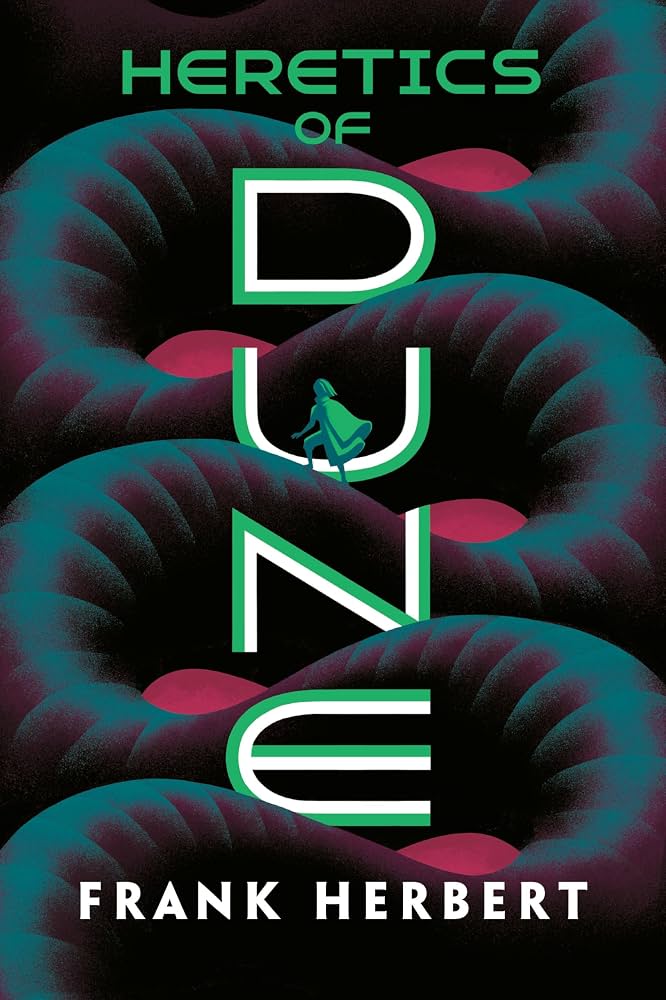
Heretics of Dune by Frank Herbert
Heretics of Dune by Frank Herbert is the fifth novel in the original six-book Dune saga, continuing one of the most influential science-fiction series ever written.
Set roughly 1,500 years after the reign of Leto II, the God Emperor, the novel reveals a universe transformed by the consequences of his enormous political and evolutionary experiment.
Humanity has spread far beyond the boundaries of the old Imperium in an event known as the Scattering. Now, generations later, people from those distant reaches of space are beginning to return.
Their arrival brings new powers, unfamiliar cultures and a threat that could completely reshape the surviving institutions of the old universe.
Official Gollancz material identifies Heretics of Dune as Book 5 in Frank Herbert’s six-volume sequence, following God Emperor of Dune and preceding Chapterhouse: Dune.
Return to Rakis
The planet once known as Arrakis has changed again.
After centuries of ecological transformation, the world called Rakis is returning to the desert conditions that once defined Dune.
The great sandworms remain central to the planet’s religious, ecological and political importance, but their future is uncertain.
At the same time, a remarkable young girl named Sheeana emerges on Rakis.
She possesses an extraordinary relationship with the sandworms, and that ability gives her immediate religious and political significance.
Different factions begin to realise that controlling—or influencing—Sheeana could affect the future of humanity.
The Bene Gesserit
The Bene Gesserit play an especially important role in Heretics of Dune.
For thousands of years, the Sisterhood has worked behind the scenes, guiding bloodlines, politics and social development through careful observation and manipulation.
But the post-Scattering universe is becoming increasingly difficult for them to control.
New forces have emerged.
Old assumptions are becoming unreliable.
And the Bene Gesserit must decide how much they are willing to change in order to survive.
Characters such as Mother Superior Taraza, Darwi Odrade, Lucilla and the legendary military commander Miles Teg bring different perspectives to the Sisterhood’s struggle.
Duncan Idaho Returns
One of the most enduring characters in the Dune saga, Duncan Idaho, again becomes important.
Across thousands of years, versions of Duncan have repeatedly been recreated as gholas by the Bene Tleilax.
In Heretics of Dune, another young Duncan ghola is being prepared for a purpose that even he does not fully understand.
His existence connects the distant future of this novel with people and events stretching back to the earliest days of the Atreides family.
Frank Herbert uses Duncan to explore one of the series’ recurring questions: how much of a person’s identity comes from memory, biology, experience and choice?
The Honoured Matres
One of the novel’s major new forces is the Honoured Matres.
They are returning from the Scattering with enormous power and ambitions of their own.
Their methods, values and abilities make them a serious threat to organisations that have survived for thousands of years.
Their arrival creates a conflict that becomes central not only to Heretics of Dune but also to the final Frank Herbert novel, Chapterhouse: Dune.
The Honoured Matres also give the story a different political balance from earlier Dune novels.
The old universe is no longer dominated entirely by familiar institutions such as the Bene Gesserit, Bene Tleilax and Ixians. Humanity’s expansion has created new cultures that cannot easily be understood or controlled by the organisations left behind.
Science Fiction, Politics and Ecology
Like the earlier books in the series, Heretics of Dune combines large-scale science fiction with philosophical and political questions.
Readers can expect themes involving:
- political power
- religion
- ecological change
- genetic manipulation
- human evolution
- institutional survival
- memory and identity
- sexuality and control
- prophecy
- social engineering
- freedom
- adaptation
- long-term consequences of power
The Dune saga is particularly known for examining how political and religious systems develop around charismatic leaders.
By the time of Heretics of Dune, the universe has had thousands of years to experience the consequences of Paul Atreides and Leto II.
The novel asks what happens when humanity finally begins escaping the systems created to control its future.
The Scattering
The Scattering is essential to understanding the setting.
After generations of control under the God Emperor, enormous numbers of humans spread outward into previously unexplored areas of the universe.
That movement created countless societies beyond the influence of the old Imperium.
Now some of their descendants are returning.
But they are no longer culturally identical to those who remained.
The Scattering therefore represents both freedom and uncertainty.
Humanity has become harder to destroy because it is spread across an enormous area, but it has also become impossible for any single institution to fully understand.
Dune Reading Order
For Frank Herbert’s original six novels, read:
1. Dune
2. Dune Messiah
3. Children of Dune
4. God Emperor of Dune
5. Heretics of Dune
6. Chapterhouse: Dune
Gollancz and Hachette officially present the books in this order.
Heretics of Dune should not be read as a standalone introduction to the series. It relies heavily on the political, ecological and philosophical developments of the first four books.
Who Should Read Heretics of Dune?
This book is ideal for readers who enjoy:
- epic science fiction
- space opera
- political science fiction
- ecological science fiction
- complex worldbuilding
- philosophical fiction
- long-running family sagas
- futuristic politics
- genetic and evolutionary themes
- Frank Herbert’s Dune universe
Readers who enjoyed the deeper political and philosophical elements of God Emperor of Dune will find Heretics of Dune particularly important because it shows the long-term results of Leto II’s Golden Path.
About Frank Herbert
Frank Herbert (1920–1986) was an American science-fiction author best known for creating the Dune universe.
His original Dune, published in 1965, became one of the most influential works in modern science fiction and won both the Hugo Award and the inaugural Nebula Award for Best Novel.
Herbert continued the saga across five sequels, ending with Chapterhouse: Dune in 1985.
His work is especially known for combining science fiction with ecology, religion, politics, philosophy, psychology and questions about humanity’s long-term evolution.
For readers looking to buy Heretics of Dune in Sri Lanka, ISBN 9781473233799 is an excellent matching UK Gollancz paperback edition and the correct fifth volume in Frank Herbert’s original Dune saga.






Reviews
There are no reviews yet.