







Description
Working Backwards by Colin Bryar and Bill Carr
Working Backwards by Colin Bryar and Bill Carr offers an insider’s account of the management principles, leadership practices, and operating mechanisms that helped Amazon grow from an online bookseller into one of the world’s most influential companies.
Both authors joined Amazon during the late 1990s and held senior leadership positions during a period of rapid expansion and innovation. Drawing on their direct experience, they explain how Amazon developed products and services such as Amazon Prime, Kindle, Amazon Web Services, and its digital media businesses.
Rather than claiming that Amazon succeeded through the brilliance of one individual, Working Backwards argues that repeatable processes, disciplined decision-making, customer obsession, careful hiring, and measurable execution played essential roles. The book explains these mechanisms in practical terms so that leaders can consider how to adapt them to organisations of different sizes.
What Does “Working Backwards” Mean?
Working backwards means beginning with the customer’s needs and then designing the product, service, technology, and organisation required to satisfy them.
Many businesses start with an idea, existing technology, or internal capability and then attempt to find customers for it. Amazon’s process reverses this sequence.
A team first asks:
- Who is the customer?
- What problem does the customer face?
- Why are existing solutions inadequate?
- What would make the new product meaningfully better?
- How would customers understand its value?
- What would the complete customer experience look like?
- Is the problem important enough to solve?
Only after answering these questions does the team move towards development.
This approach is intended to reduce the risk of building something impressive that customers neither need nor understand.
The PR/FAQ Process
One of the book’s best-known mechanisms is the PR/FAQ document: a proposed press release accompanied by frequently asked questions.
Before building a product, the team writes a press release describing it as though it has already launched. The document explains the customer’s problem, the proposed solution, the most important benefits, and why the product is better than available alternatives.
The FAQ then addresses difficult internal and external questions, including:
- How will the product work?
- Who is it designed for?
- What technical capabilities are required?
- How much will it cost?
- What risks could prevent success?
- What legal or operational issues must be resolved?
- How will the company measure customer adoption?
- What assumptions still need validation?
If the team cannot clearly explain the product before development begins, the underlying idea may not yet be strong enough.
The PR/FAQ process encourages clarity while changes are still inexpensive. Revising a written proposal is considerably easier than rebuilding a product after months of engineering work.
Replacing Presentations with Written Narratives
Amazon became known for replacing traditional slide presentations in many important meetings with carefully written narrative documents.
Instead of presenting a series of short bullet points, the person leading the discussion prepares a structured memo—often approximately six pages long. Meeting participants begin by reading the document silently before discussing it.
Bryar and Carr explain that narrative writing forces the author to develop a logical argument. Slides can hide weak reasoning behind attractive design, confident delivery, or incomplete phrases. Prose requires clearer connections between evidence, assumptions, problems, and recommendations.
Written narratives can improve meetings by:
- Providing participants with the same information
- Reducing dependence on presentation ability
- Encouraging deeper analysis
- Making assumptions easier to challenge
- Creating a record for future reference
- Keeping discussion focused on the proposal
- Allowing quieter participants to evaluate ideas carefully
The process requires effort, but the authors argue that the improved quality of thinking makes the investment worthwhile.
Customer Obsession
Customer obsession is central to Amazon’s operating philosophy. It differs from simply paying attention to competitors or attempting to increase short-term revenue.
A customer-obsessed organisation begins with customer needs and treats trust as a long-term asset. Teams consider how decisions affect price, convenience, selection, reliability, and the complete experience.
This does not mean agreeing with every customer request. Customers may not be able to describe a product that does not yet exist. The company must understand the deeper problem and invent a solution.
The book shows how customer obsession influences:
- Product development
- Operational targets
- Service quality
- Long-term investment
- Performance measurements
- Executive decision-making
- Organisational design
It becomes a working mechanism only when it affects what teams build, measure, and prioritise.
Leadership Principles in Daily Decisions
Amazon’s Leadership Principles are often discussed publicly, but Working Backwards focuses on how principles become useful only when embedded in everyday systems.
Values displayed on a wall have limited impact if they do not influence hiring, promotion, planning, meetings, product decisions, and performance evaluation.
The principles examined in the book include ideas such as:
- Customer obsession
- Ownership
- Invent and simplify
- Insisting on high standards
- Thinking big
- Bias for action
- Diving deep
- Earning trust
- Delivering results
Bryar and Carr demonstrate how shared principles provide a common decision-making language. Employees can challenge a proposal by referring to an agreed standard rather than relying only on personal authority.
Hiring and the Bar Raiser Process
Rapidly growing companies often struggle to maintain hiring quality. Managers under pressure may accept weaker candidates simply because a role needs to be filled quickly.
Amazon developed the Bar Raiser programme to counter this problem. A trained interviewer from outside the hiring team participates in the process and helps ensure that the candidate meets the company’s long-term standards.
The objective is to hire people who raise the overall capability of the organisation rather than merely filling vacancies.
The hiring process also uses behavioural questions that ask candidates to describe specific past experiences. Interviewers seek concrete evidence of how the individual approached decisions, conflict, ownership, failure, and results.
Important lessons include:
- Define the requirements of the role clearly.
- Assign different evaluation areas to interviewers.
- Ask for specific examples rather than general opinions.
- Record evidence immediately.
- Avoid allowing one influential person to control the decision.
- Protect hiring standards during periods of rapid growth.
- Evaluate the candidate against the role, not against other applicants.
Single-Threaded Leadership
Large organisations frequently assign important projects to executives who already manage several unrelated responsibilities. The project then competes for attention and resources.
Amazon’s response was the single-threaded leader: one person whose primary responsibility is to deliver a clearly defined initiative. That leader receives a dedicated team with sufficient authority and resources.
Single-threaded leadership can improve:
- Accountability
- Decision-making speed
- Focus
- Coordination
- Ownership
- Resource allocation
- Measurement of results
The word “single-threaded” does not mean that the leader performs only one task. It means that the initiative is not treated as a secondary responsibility.
This structure played an important role in building large, complex services that required sustained attention.
Two-Pizza Teams
Amazon is also associated with the idea that a team should be small enough to be fed with two pizzas. The exact number is less important than the underlying principle: smaller teams often communicate and make decisions more efficiently.
However, the authors explain that team size alone is insufficient. A team must also possess clear ownership, suitable metrics, technical independence, and the authority to make decisions.
An effective small team should understand:
- The customer it serves
- The problem it owns
- The systems it controls
- Its required results
- The metrics used to evaluate performance
- Its relationships with other teams
The goal is to reduce coordination costs while giving teams meaningful responsibility.
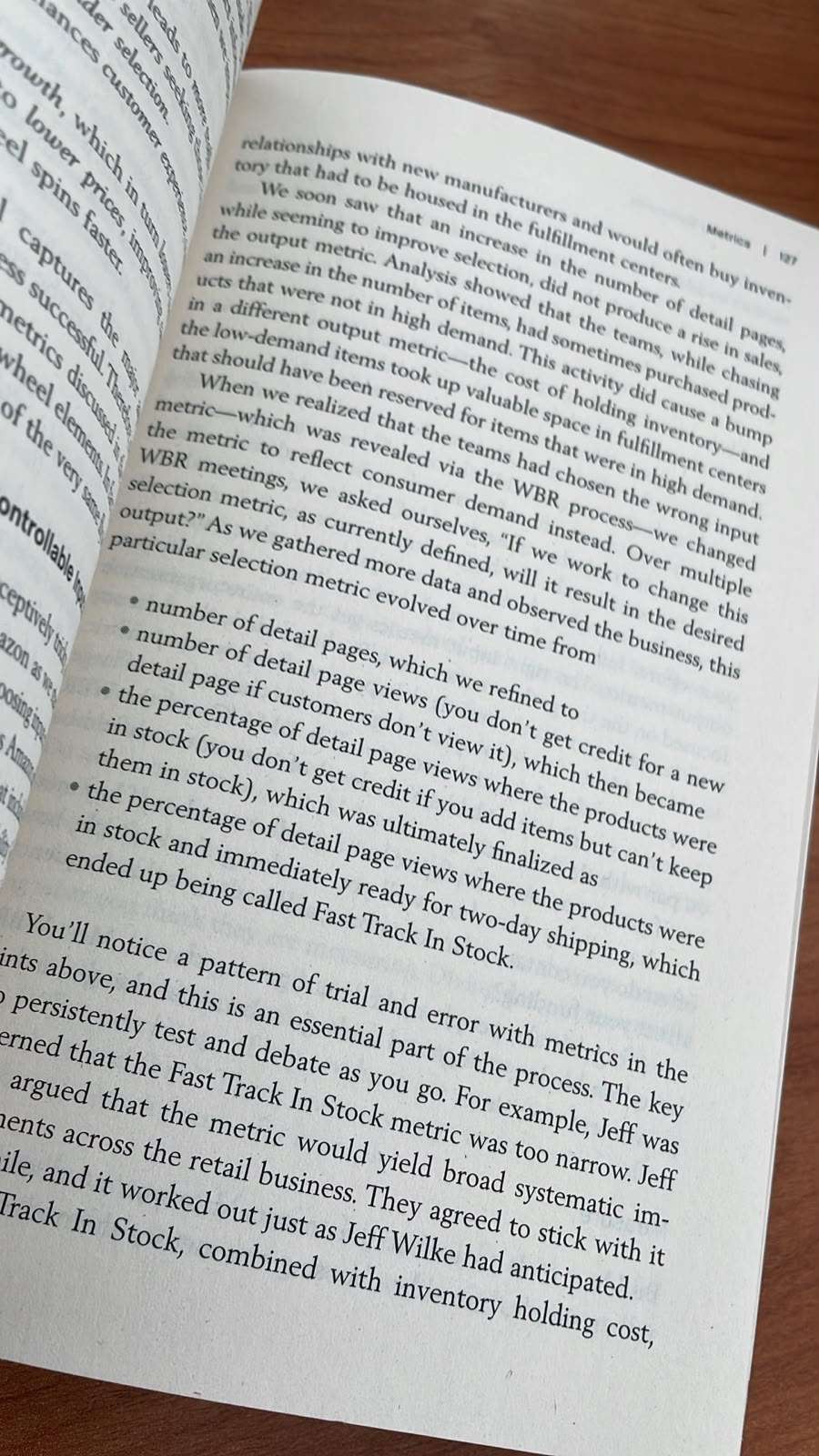
Input Metrics and Output Metrics
Businesses naturally monitor outcomes such as revenue, profit, market share, and customer growth. These are output metrics. They show what happened but may not explain what employees can do differently today.
Amazon also emphasised input metrics—measurable activities or conditions that teams can directly influence.
For example, a company may not be able to command customers to purchase more products. It can improve selection, availability, pricing, delivery speed, and service reliability. These inputs may then affect sales and customer retention.
Useful metrics should be:
- Clearly defined
- Controllable by the responsible team
- Connected to customer value
- Measured consistently
- Difficult to manipulate
- Reviewed regularly
- Updated when circumstances change
The book also warns that poorly selected metrics can create misleading incentives. Teams must repeatedly test whether an input genuinely produces the intended outcome.
Weekly Business Reviews
The Weekly Business Review, or WBR, is a disciplined meeting used to examine operational performance through a consistent collection of metrics.
Its purpose is not simply to report numbers. Leaders investigate unexpected changes, identify problems, understand causes, and decide what action is required.
A productive review focuses on questions such as:
- What changed?
- Why did it change?
- Is the change temporary or structural?
- Which customer experience was affected?
- Who owns the issue?
- What corrective action is underway?
- When should the metric improve?
- Does the current measurement remain useful?
Regular reviews help leaders identify problems early and maintain attention on operational details.
Learning from Successful and Failed Initiatives
Working Backwards includes stories behind major Amazon initiatives and explains how the company’s mechanisms influenced their development.
The authors discuss innovations connected with:
- Amazon Prime
- Kindle
- Amazon Web Services
- Digital music and video
- Marketplace expansion
- Organisational restructuring
The book does not portray every Amazon project as successful. Failures and incorrect assumptions provide important evidence about the limits of any management system.
A disciplined process cannot guarantee that every idea will work. It can improve the quality of decisions, expose weaknesses earlier, and help organisations learn systematically from outcomes.
Long-Term Thinking
Many of Amazon’s major investments required years before producing significant financial results. Leaders needed to tolerate uncertainty while continuing to measure progress.
Long-term thinking does not mean ignoring performance or investing without discipline. It means accepting short-term costs when evidence suggests that an initiative can create substantial customer value and build a durable advantage.
The authors show that long-term decisions require:
- A clearly defined customer benefit
- Leadership commitment
- Appropriate input metrics
- Dedicated ownership
- Patience supported by evidence
- Willingness to challenge assumptions
- Continued operational discipline
Applying the Lessons Outside Amazon
The authors do not suggest copying every Amazon practice without modification. A start-up, retailer, non-profit organisation, government department, and multinational company operate under different conditions.
Readers are encouraged to understand the purpose of each mechanism and adapt it carefully.
A company might begin by:
- Writing a PR/FAQ for one proposed product
- Replacing one slide presentation with a narrative memo
- Identifying controllable input metrics
- Creating a structured weekly operational review
- Assigning a dedicated leader to a critical initiative
- Improving behavioural interviewing
- Clarifying team ownership
- Starting product discussions with the customer’s problem
Experimenting with one mechanism makes it easier to evaluate whether it improves decision-making before attempting a wider transformation.
About Colin Bryar
Colin Bryar joined Amazon in 1998 and spent twelve years in senior leadership roles. He served as a vice president and worked closely with Jeff Bezos as his technical adviser, a position sometimes described as “Jeff’s shadow.”
This role gave him direct access to executive meetings, strategic decisions, operating reviews, and the development of Amazon’s leadership mechanisms.
About Bill Carr
Bill Carr joined Amazon in 1999 and held leadership roles across the company’s digital media businesses. His work included digital music and video as Amazon expanded beyond physical retail into technology, services, and entertainment.
Together, Bryar and Carr combine operational guidance with firsthand accounts of Amazon’s development.
Who Should Read Working Backwards?
This book is suitable for:
- Business owners
- Managers and team leaders
- Entrepreneurs and start-up founders
- Product managers
- Operations professionals
- Human-resources and recruitment leaders
- Technology executives
- Business and management students
- Consultants
- Anyone interested in Amazon’s internal practices
Book Links
Search for Working Backwards by Colin Bryar and Bill Carr at Book Lounge Sri Lanka:
Working Backwards – Book Lounge Search
Practical Management Lessons from Inside Amazon
Working Backwards by Colin Bryar and Bill Carr explains how Amazon transformed broad values into concrete mechanisms governing product development, hiring, communication, team design, metrics, and execution.
Its most useful lesson is that organisational excellence does not emerge from slogans alone. It requires clearly defined processes that leaders and teams follow consistently. With practical tools such as PR/FAQ documents, narrative memos, Bar Raiser interviews, input metrics, and single-threaded leadership, the book offers ideas that organisations can test and adapt to their own needs.





Reviews
There are no reviews yet.