










Description
Think Like a Monk by Jay Shetty is an inspiring and practical personal-development book about training the mind for greater peace, clarity and purpose. Drawing on principles Shetty associates with his experience of monastic practice, the book translates ancient wisdom into exercises that readers can apply to modern relationships, work, habits and personal challenges.
Modern life constantly competes for attention. Social media, opinions, comparison, work pressure and other people’s expectations can make it difficult to recognise what genuinely matters.
Shetty argues that thinking like a monk does not require abandoning ordinary life or moving into an ashram. Instead, it means learning to observe the mind, question unhelpful habits and make decisions according to carefully chosen values.
The book explores how people can release influences that no longer serve them, strengthen positive routines and use their abilities in ways that benefit others.
It combines personal stories, philosophical ideas, reflective questions and practical exercises intended to help readers move from automatic reactions towards more deliberate living.
What Is Think Like a Monk by Jay Shetty About?
Think Like a Monk by Jay Shetty examines how people can develop a calmer and more purposeful approach to everyday life.
The book is organised around three broad stages: letting go of unhelpful influences, developing stronger internal habits and using personal growth to contribute to other people.
Readers are encouraged to examine the sources of their beliefs, fears and ambitions. Some goals may reflect genuine personal values, while others may have been adopted mainly to earn approval or avoid criticism.
Shetty presents the monk mindset as courageous, compassionate and disciplined. It does not require ignoring practical responsibilities or pretending that difficult emotions do not exist.
Instead, the approach encourages readers to understand their thoughts without automatically allowing every thought to control their actions.
Part One: Let Go of What Holds You Back
The opening section concentrates on influences that can prevent clarity and meaningful progress.
These include identities built around other people’s expectations, repeated negativity, uncontrolled fear and intentions based mainly on status or external approval.
Letting go does not require forgetting every difficult experience. It involves recognising which beliefs, emotional patterns and relationships continue shaping behaviour in unhelpful ways.
Readers are encouraged to create space between an event and their response. This space makes it possible to choose an action rather than reacting automatically.
Identity and Other People’s Expectations
Identity is one of the first major themes in Think Like a Monk.
People often absorb opinions from family, friends, teachers, colleagues, advertising and social media. Over time, these outside voices may become difficult to distinguish from personal values.
A career may be pursued because it appears impressive. A lifestyle may be copied because it receives approval. A person may hide an interest or ambition because they fear criticism.
Shetty encourages readers to examine the origin of their goals and beliefs.
A useful question is whether a particular ambition would remain meaningful without praise, recognition or comparison.
This process can help readers build an identity based on principles and genuine interests rather than continuously changing themselves to satisfy other people.
Understanding and Reducing Negativity
Negativity can influence attention, relationships and decision-making.
Repeated complaining, criticism and exposure to unhealthy environments may train the mind to notice problems while ignoring available opportunities or positive experiences.
The book does not suggest denying every difficulty or forcing constant positivity. Problems need to be recognised before they can be addressed responsibly.
However, there is a difference between identifying a genuine problem and repeatedly concentrating on what cannot be changed.
Readers are encouraged to notice the language they use, the conversations they participate in and the emotional effect of the people around them.
Reducing unnecessary negativity can create more attention for constructive action.
Using Fear as Useful Information
Fear is a natural response to uncertainty, danger and possible loss.
Shetty encourages readers to investigate fear rather than immediately obeying or suppressing it.
Some fears provide useful warnings. Others are connected with embarrassment, imagined criticism or memories of previous failures.
Writing down a fear can make it more specific. Once identified, it becomes easier to ask what evidence supports it, what can be controlled and what practical preparation may reduce the risk.
Courage does not require the complete absence of fear. It involves acting according to meaningful values even when uncertainty remains.
The book therefore presents fear as something that can be studied and redirected rather than a permanent definition of personal ability.
Living with Clear Intention
Actions can produce very different results depending on the intention behind them.
A person may help someone because they genuinely care, because they want recognition or because they fear being disliked.
The outward action may appear similar, but the internal motivation affects how the person experiences it.
Shetty encourages readers to examine the reasons behind important goals and choices.
Intentions based entirely on ego, comparison or public approval may provide temporary satisfaction but often require continuous outside validation.
Intentions connected with learning, service, integrity and meaningful contribution can provide a more stable direction.
Part Two: Grow Through Purpose and Discipline
After examining what should be released, the book turns towards developing stronger habits and a clearer sense of direction.
This section explores purpose, routines, the mind and the ego.
Growth is not presented as one dramatic transformation. It usually develops through ordinary choices repeated consistently.
A meaningful purpose provides direction, while routines turn that direction into practical behaviour.
Training the mind helps readers manage attention, and recognising the ego makes it easier to learn from mistakes and other people.
Discovering Your Purpose or Dharma
Purpose is one of the central subjects in Think Like a Monk by Jay Shetty.
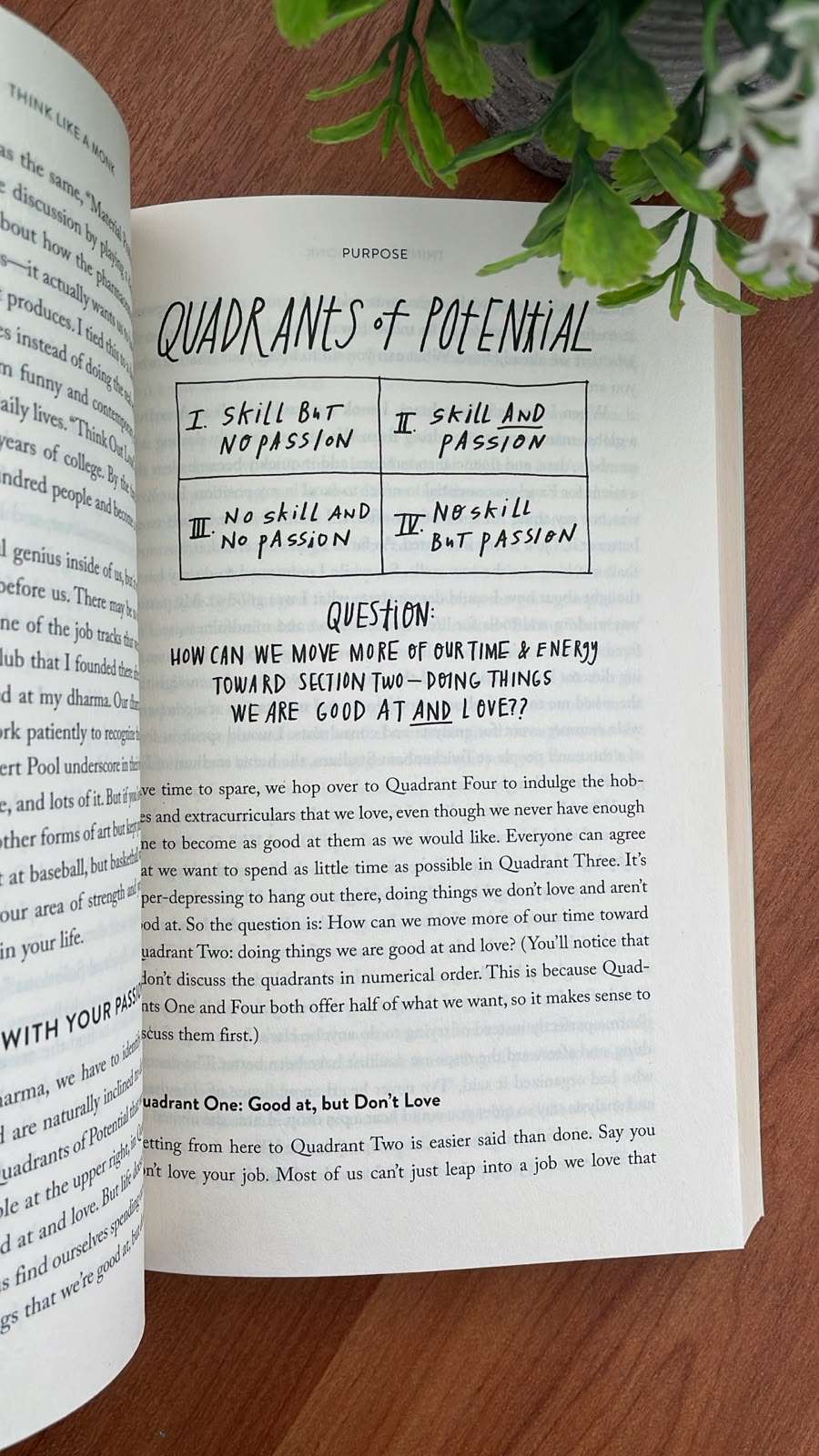
Shetty discusses the idea of dharma as the intersection of natural abilities, personal interests and service to others.
Purpose is not always one perfect career discovered in a sudden moment of inspiration. It may emerge gradually through experimentation, learning and careful observation.
Readers can begin by noticing which activities create energy, which abilities others regularly appreciate and which problems they feel motivated to help solve.
A skill becomes more meaningful when it creates value beyond personal recognition.
Someone who enjoys communication may use that ability in teaching, management, customer service, writing or community work. The expression may change while the deeper purpose remains similar.
The Importance of Routine
A meaningful goal requires habits that support it.
Routines reduce the number of decisions required during the day. When useful actions have a regular time and place, less energy is spent deciding whether to begin.
The book discusses morning and evening practices as opportunities to prepare and reflect.
A morning routine may include silence, gratitude, movement, reading or planning. An evening routine may involve reviewing the day, reducing digital stimulation and preparing for rest.
The exact routine should match the reader’s responsibilities rather than copying another person’s schedule without adjustment.
Consistency is more important than creating an impressive routine that cannot be maintained.
Training the Mind and Improving Focus
The mind produces thoughts continuously, but every thought does not deserve equal attention.
Shetty encourages readers to observe thoughts instead of immediately identifying with them.
A thought such as “I will fail” is not necessarily a reliable prediction. It may reflect fear, fatigue or a previous experience.
Creating distance from a thought makes it possible to examine whether it is accurate and useful.
Focus can also be strengthened by reducing unnecessary distractions. Attempting to complete several demanding activities at the same time may weaken attention and increase mistakes.
Choosing one clear task and protecting time for it can support deeper and more satisfying work.
Managing Overthinking
Overthinking often appears productive because the mind remains active. However, repeatedly examining the same problem without making a decision may create exhaustion rather than progress.
The book encourages readers to separate useful reflection from repetitive mental activity.
Useful reflection produces information, options or a next step. Unproductive overthinking repeats fears without changing the available evidence.
Writing down concerns can help organise them. Readers can identify what requires action, what requires more information and what remains outside their control.
A small practical step may reduce uncertainty more effectively than another hour of private worry.
Understanding the Ego
Ego can make people dependent on status, praise and the need to appear correct.
A person controlled by ego may resist feedback, hide mistakes or treat another person’s success as a personal threat.
The book encourages confidence without constant self-promotion.
Humility does not require denying personal strengths. It means understanding that ability can continue developing and that useful knowledge may come from unexpected people.
Recognising the ego can also improve relationships. Not every disagreement needs to be won, and not every criticism needs an immediate defensive response.
Sometimes the most productive choice is to listen, ask questions and decide whether the feedback contains something useful.
Part Three: Give Through Gratitude and Service
The final part of the book moves beyond individual improvement.
Shetty argues that peace and purpose become deeper when personal abilities are used to support relationships, communities and meaningful service.
This section explores gratitude, compatibility in relationships and contributing to other people.
Personal growth that remains focused entirely on the self can become another form of ego. Service connects inner development with the wider world.
Developing a Meaningful Gratitude Practice
Gratitude is more than creating a quick list of pleasant things.
A deeper practice involves paying attention to why an experience, person or opportunity matters.
Instead of writing only “I am grateful for my family,” a reader might identify one specific action that made them feel supported.
Specific gratitude strengthens awareness because it requires recalling details that may otherwise be forgotten.
Gratitude does not mean ignoring disappointment, injustice or grief. Difficult experiences remain real.
It provides a way to recognise that positive and painful parts of life can exist at the same time.
Building Healthier Relationships
Think Like a Monk examines relationships through values, trust and compatibility.
Attraction or familiarity alone may not create a healthy long-term relationship. People also need to consider communication, expectations, emotional responsibility and shared principles.
The book encourages readers to recognise the different roles people may have in their lives.
One friend may provide emotional support, while another shares professional knowledge or creative interests. Expecting one person to meet every need can place unrealistic pressure on the relationship.
Healthy relationships also require boundaries. Compassion does not require accepting manipulation, disrespect or repeated harmful behaviour.
Service and the Use of Personal Gifts
Service is presented as an important source of meaning.
People often discover greater purpose when they use their knowledge, time or abilities to make another person’s life better.
Service does not need to involve a famous charity or a large public project. It can appear through teaching, listening, mentoring, caring for family or completing work that genuinely helps customers and colleagues.
The most useful form of service often connects personal strengths with an actual need.
Someone skilled in organisation may help a community project. A strong reader may support a younger student, while a business owner may create fair employment and valuable products.
Service transforms personal development from private achievement into meaningful contribution.
Mindfulness in Modern Daily Life
The book offers practical methods for bringing greater awareness into ordinary routines.
Mindfulness can begin by noticing the current task, physical surroundings and emotional state without immediately judging them.
During a conversation, this may mean listening without preparing a response while the other person is still speaking.
During work, it may mean reducing interruptions and concentrating on one priority.
During a difficult emotional moment, it may mean pausing before sending a message or making an important decision.
These small practices create opportunities to respond intentionally rather than acting entirely through habit.
Practical Exercises in Think Like a Monk
The book includes reflective questions and exercises designed to help readers apply its ideas.
Readers may be encouraged to identify values, examine fears, assess relationships, practise gratitude or design more effective daily routines.
Completing these exercises can make the reading experience more useful than simply highlighting motivational statements.
A journal can be used to record answers, review recurring patterns and measure whether a new habit is becoming consistent.
Readers do not need to apply every idea simultaneously. Selecting one relevant principle and practising it regularly may be more effective than attempting a complete personal transformation in one week.
Think Like a Monk Is Not Medical Treatment
This book is a personal-development and mindfulness guide. It is not a substitute for professional mental-health care, diagnosis or treatment.
Readers experiencing severe or persistent anxiety, depression, trauma or other mental-health concerns should seek support from a qualified professional.
The book’s exercises may be used for reflection and habit development, but individual needs and circumstances differ.
Important Themes in Think Like a Monk
Identity and Values
Readers are encouraged to distinguish personal values from identities created mainly to satisfy other people.
Negativity and Attention
Reducing unnecessary negativity can create more mental space for constructive choices.
Fear and Courage
Fear can be examined as information rather than automatically treated as a command.
Purpose and Dharma
Purpose may develop where personal strengths, meaningful interests and service to others meet.
Routine and Discipline
Consistent habits help translate intentions into practical daily behaviour.
Mindfulness and Focus
Observing thoughts and protecting attention can reduce automatic reactions and distraction.
Gratitude and Service
Personal development becomes more meaningful when it strengthens appreciation and contribution.
Who Should Read Think Like a Monk?
This book is an excellent choice for readers interested in:
- Personal development and self-awareness
- Mindfulness and meditation
- Finding greater purpose and direction
- Reducing overthinking and distraction
- Creating effective morning and evening routines
- Managing fear and negative thought patterns
- Developing gratitude and healthier relationships
- Ancient wisdom presented for modern life
- Purposeful work and service to others
11 Powerful Lessons from Think Like a Monk
- Examine whether your identity reflects your values or other people’s expectations.
- Protect your attention from repeated and unnecessary negativity.
- Study your fears instead of allowing them to control every decision.
- Choose intentions based on values rather than recognition alone.
- Look for purpose where your abilities, interests and service meet.
- Create routines that make meaningful actions easier to repeat.
- Observe your thoughts without believing that every thought is true.
- Reduce the ego’s need to appear superior or permanently correct.
- Practise specific and thoughtful gratitude.
- Build relationships around trust, values and healthy boundaries.
- Use your strengths to contribute to people beyond yourself.
About Jay Shetty
Jay Shetty is an author, podcaster and storyteller whose work focuses on purpose, mindfulness, relationships and personal development.
He is also the author of 8 Rules of Love: How to Find It, Keep It, and Let It Go.
In Think Like a Monk by Jay Shetty, he presents principles associated with monastic thinking through stories, exercises and guidance intended for modern readers.
The book concentrates on developing peace and purpose without requiring readers to withdraw from careers, families or ordinary responsibilities.
Order Think Like a Monk by Jay Shetty in Sri Lanka
Think Like a Monk by Jay Shetty is a valuable choice for readers seeking practical guidance on purpose, mindfulness, routines, gratitude and personal growth.
Its eleven central themes encourage readers to release unhelpful influences, train their attention and use their abilities in ways that support both individual well-being and meaningful contribution.
Order Think Like a Monk by Jay Shetty online in Sri Lanka and discover practical tools for approaching modern life with greater peace, clarity and purpose.
Explore more personal-development books available from Bargain Books.
Learn more about the chapters and exercises on the official Think Like a Monk website.





Reviews
There are no reviews yet.